
PVG
Liquid Crystal Polarization Volume Grating
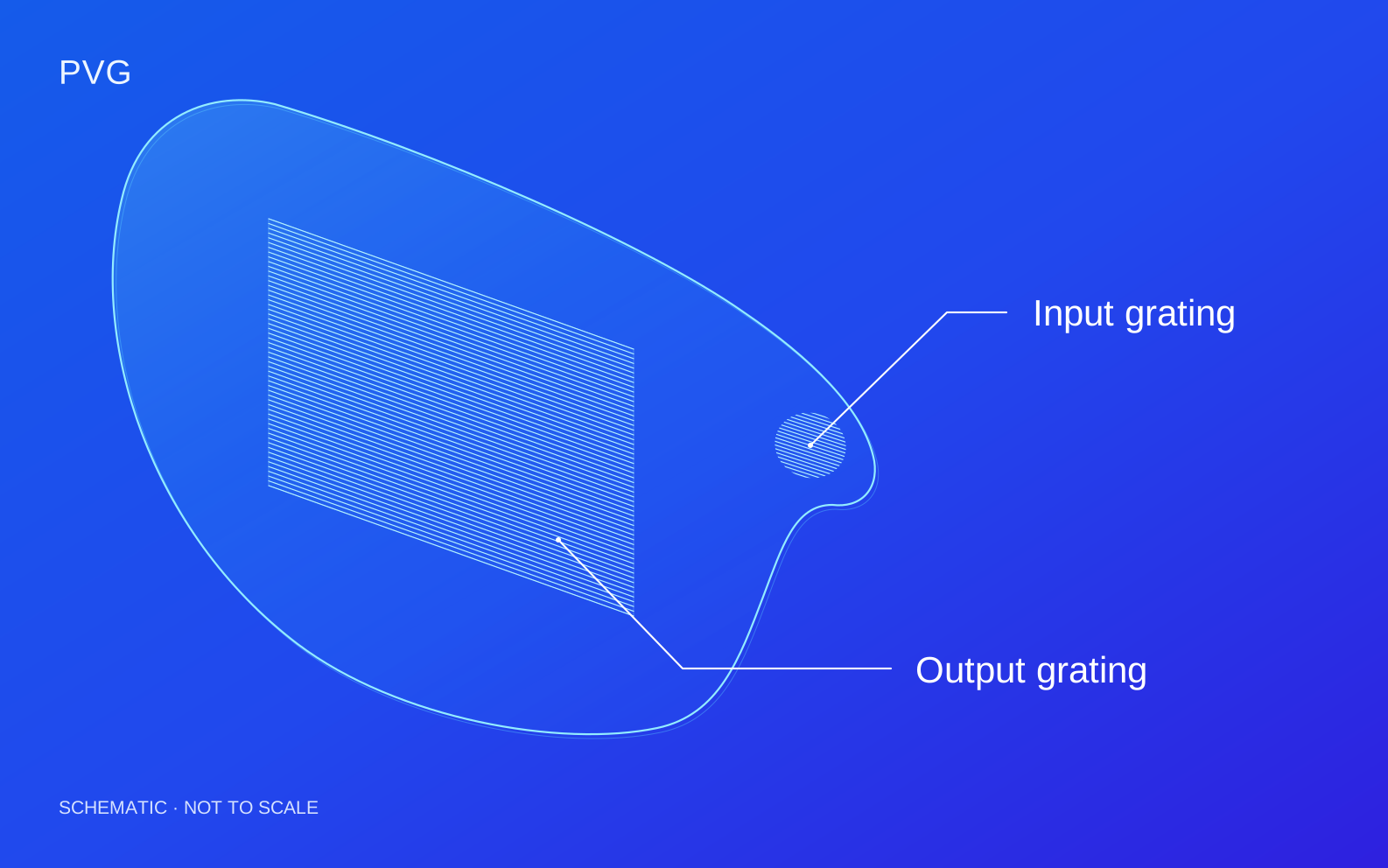
Three-dimensional liquid crystal orientation provides polarization-selective volume diffraction for AR waveguide input and output coupling.
Principles & design requirementsPRODUCT PORTFOLIO
Eight product families cover polarization volume gratings, tunable and geometric phase lenses, beam steering and polarization gratings, reflective polarizing films, achromatic waveplates and lenses, reflective PVLs and GRIN LC lenses. Each page explains principles, characteristics, applications and design inputs.
PVG
Three-dimensional liquid crystal orientation provides polarization-selective volume diffraction for AR waveguide input and output coupling.
Principles & design requirements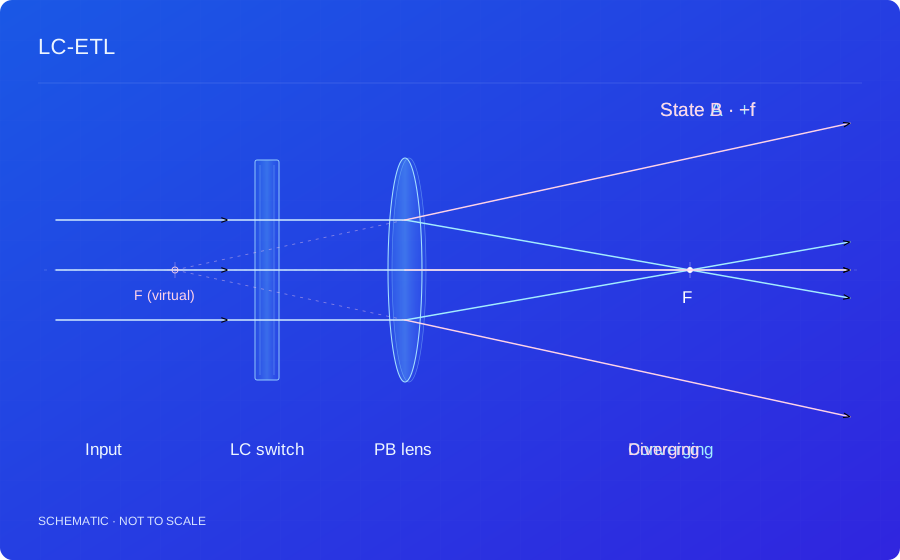
LC-ETL
PB geometric phase encodes the lens wavefront; an electrical polarization switch can select focal states without translating the lens.
Principles & design requirements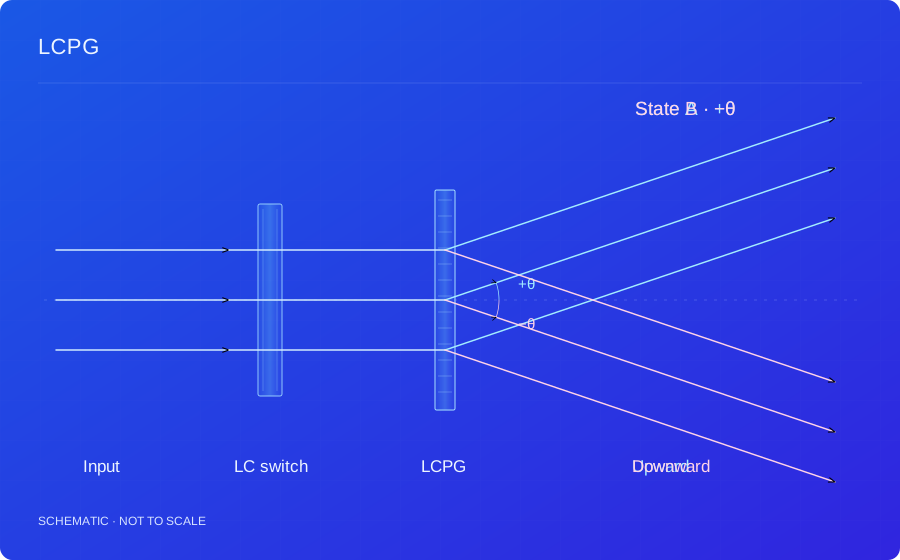
LCPG
Periodic liquid crystal orientation creates opposite geometric-phase gradients; a polarization switch selects +θ or −θ beam deflection.
Principles & design requirements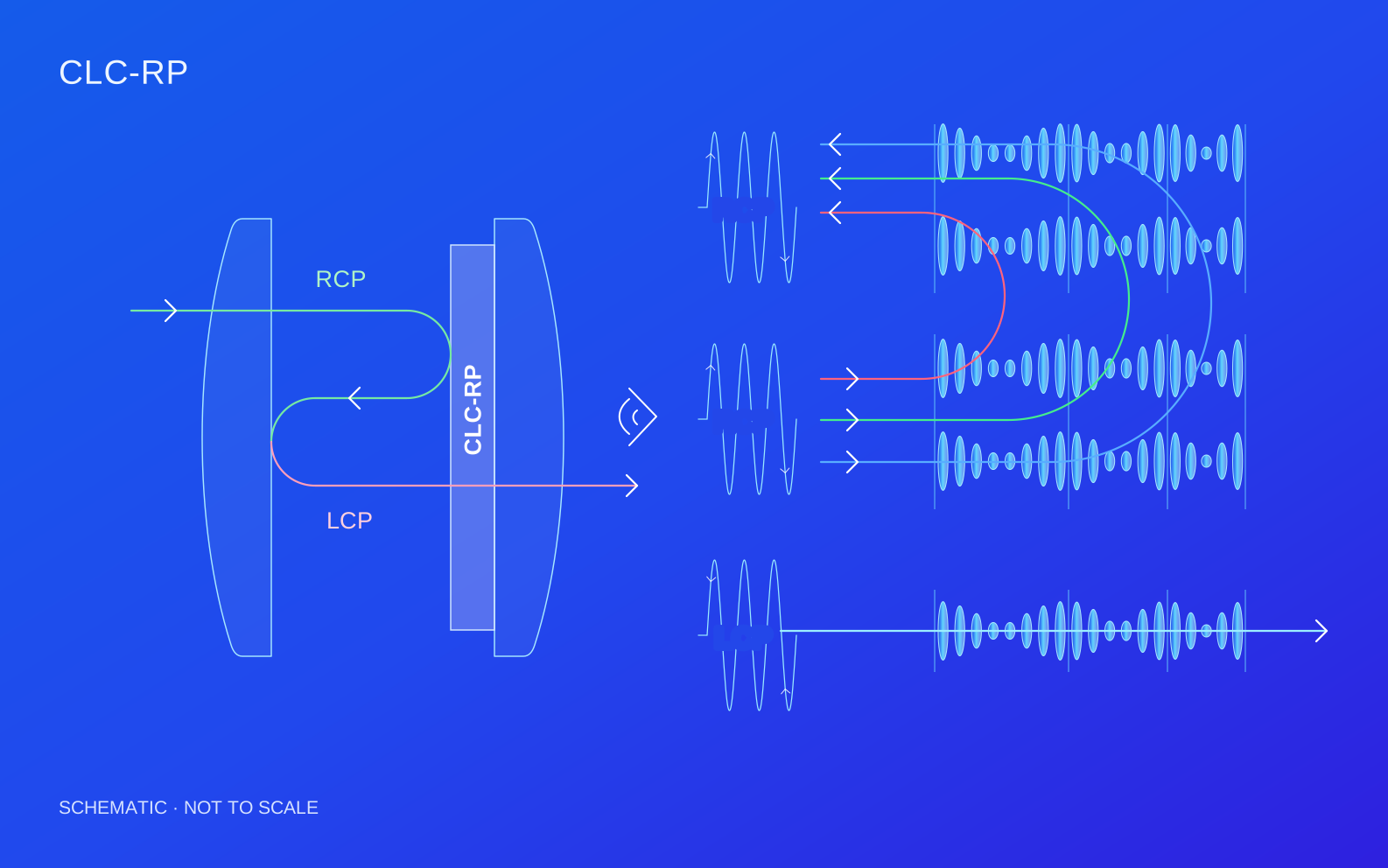
CLC-RP
The helical structure of a cholesteric liquid crystal polymer selectively reflects and transmits circular polarization within its reflection band.
Principles & design requirements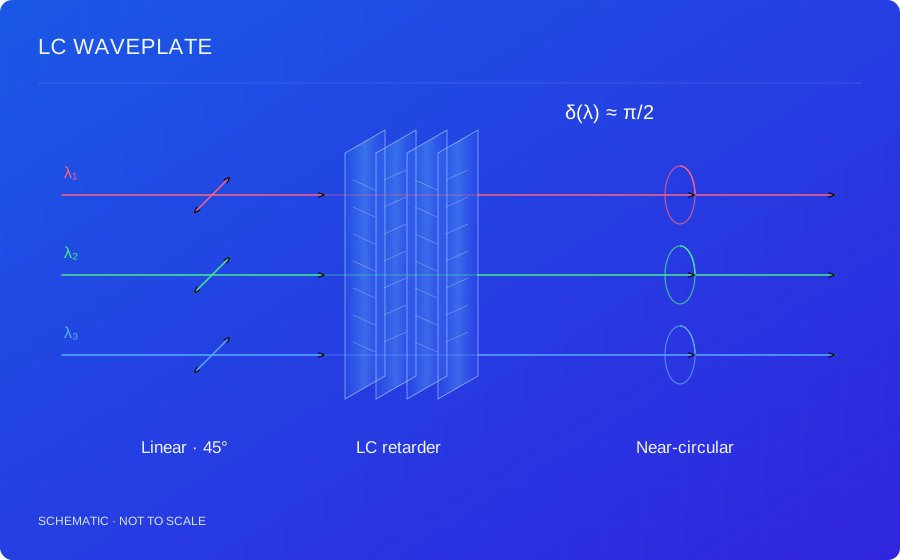
LC WAVEPLATE
Liquid crystal birefringence and multilayer orientation design control retardance and polarization-conversion error across a specified spectral band.
Principles & design requirements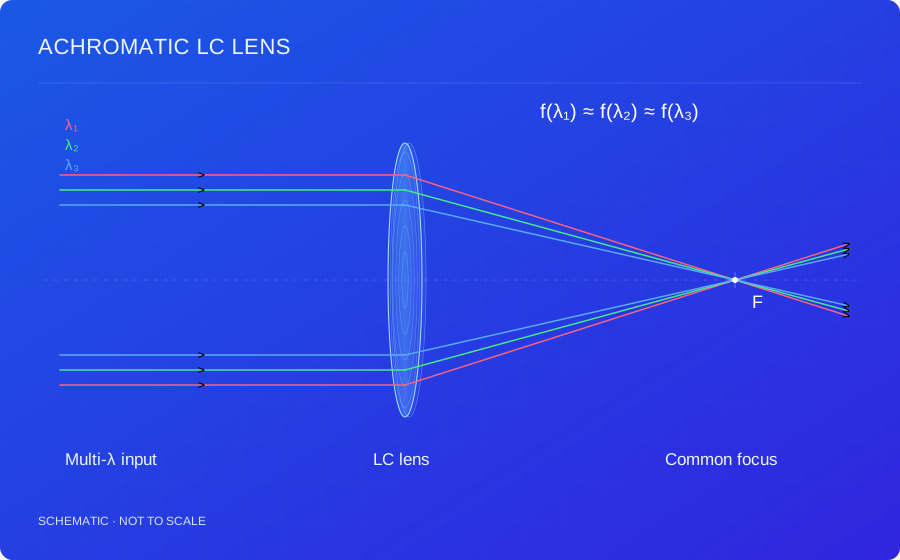
ACHROMATIC LC LENS
Co-design of phase and dispersion targets consistent focal position, residual chromatic error and image quality over the operating band.
Principles & design requirements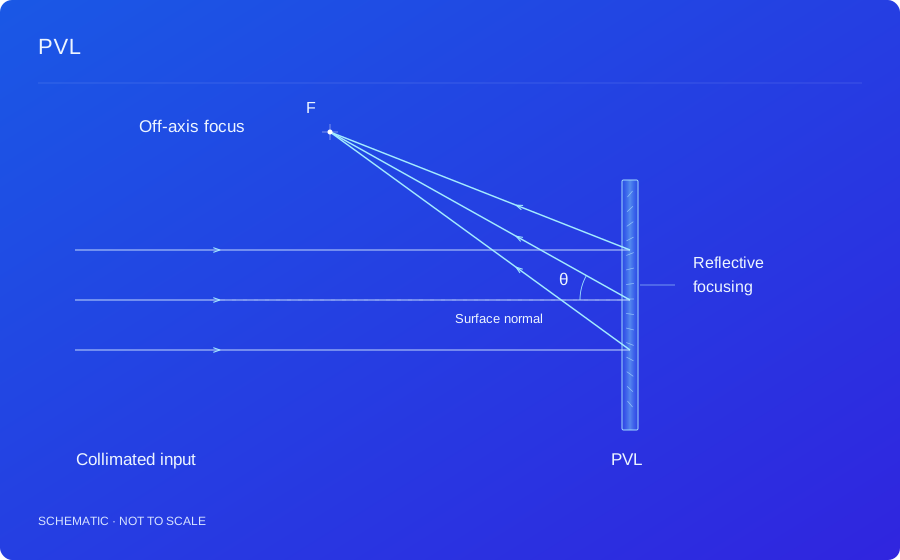
PVL
A spatially varying liquid crystal polarization volume structure combines reflective deflection and off-axis focusing in one element.
Principles & design requirements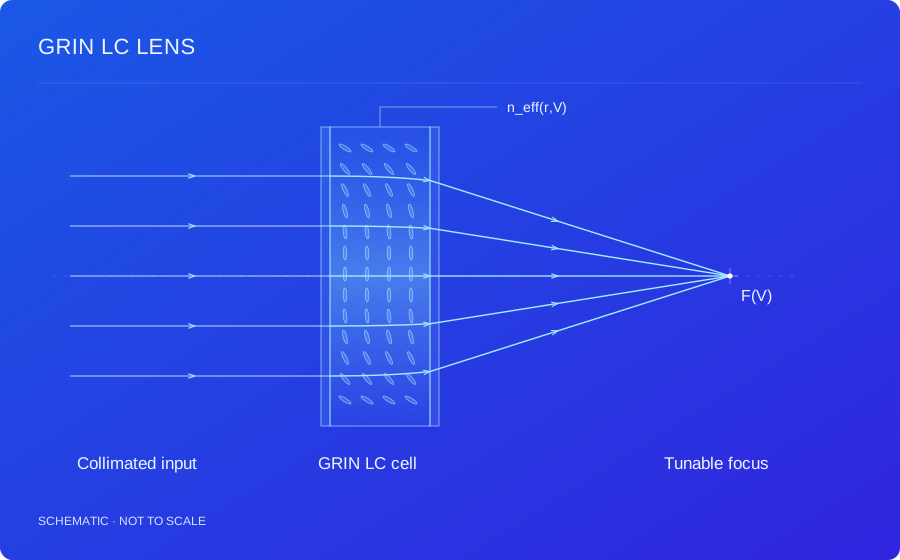
GRIN LC LENS
Electrical control of liquid crystal orientation and the effective-index profile creates a tunable lens phase within a planar LC cell.
Principles & design requirementsAdditional development areas include phase modulation, beam shaping, splitting, combined elements and optical arrays. Explore custom development →
TECHNICAL REQUIREMENTS
Share the target optical function, spectrum, aperture, polarization and system-integration conditions.