
Reduce spectral focal-position variation
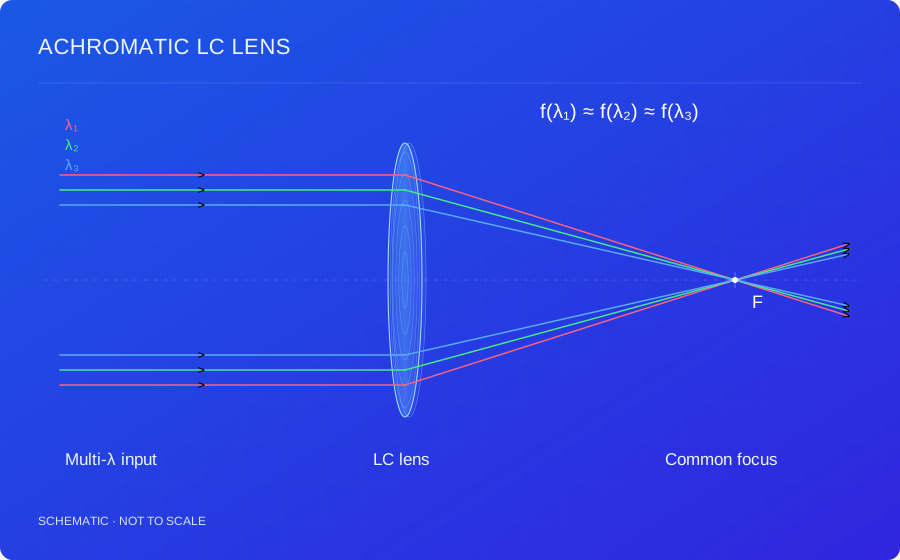
Achromatic design targets reduced focal-plane shifts so multiple wavelengths can share a focusing or imaging location.
ACHROMATIC LC LENS
Co-design of phase and dispersion targets consistent focal position, residual chromatic error and image quality over the operating band.
PRODUCT TERMINOLOGY
Broadband Achromatic Liquid Crystal Lens
Related names: Broadband Achromatic LC Lens, Achromatic Liquid Crystal Lens
| Name / abbreviation | English expansion | Meaning & scope |
|---|---|---|
| Achromatic LC lens | Achromatic Liquid Crystal Lens | A liquid crystal lens designed for focal consistency and residual chromatic error over a specified wavelength range. |
| LC lens | Liquid Crystal Lens | The general device class; the name alone does not imply broadband achromatism. |
| PBL / GPL | Pancharatnam–Berry Lens / Geometric Phase Lens | A phase-encoding mechanism. Geometric phase alone does not establish common-focus behavior across wavelengths. |
No additional universal abbreviation is assigned here. Achromatism, broadband polarization conversion and focal-state switching are distinct design targets.
01 / HOW IT WORKS
A lens requires different optical-path compensation at different aperture positions. To focus several wavelengths at the same location, the target phase must vary appropriately with wavelength. A quadratic phase describes the target in the paraxial approximation.
φ(r,λ) ≈ −πr² / [λftarget]
r is radial position, λ is the wavelength under the specified medium convention, and f_target is the design focal length. High-NA or nonparaxial systems require a complete wavefront model.
Orientation determines PB phase encoding, but a fixed phase distribution does not automatically make focal length independent of wavelength. Broadband polarization-conversion efficiency also differs from common-focus performance. Achromatic lenses must address spectral phase curvature, polarization conversion and system chromatic error together.
Assessment combines liquid crystal dispersion, orientation and layer architecture with other allowed optical elements to determine the achievable spectral phase response. For hybrid optics, identify the roles of the LC element and compensators, and evaluate residual focus shift and image quality of the complete system.
Specify wavelength interval, focal length, clear aperture, field of view, input polarization and allowable chromatic error. Validation may include focal-plane position versus wavelength, wavefront error, point-spread function or MTF, efficiency and off-axis behavior. Architecture and delivery targets follow design assessment and prototype measurements.
Background: LC polarization holography, geometric phase and volume diffraction ↗
02 / TECHNICAL BENEFITS
Achromatic design targets reduced focal-plane shifts so multiple wavelengths can share a focusing or imaging location.
Allocate optical power and compensation between LC phase structures and other permitted optical components.
Film-based phase structures offer design variables beyond surface shape and can be assessed against band, aperture, polarization and packaging.
03 / DESIGN INPUTS
These are the inputs for a design assessment, not fixed product specifications. Numerical performance, test conditions and delivery scope are confirmed for the agreed design.
| Parameter | Requirements to discuss |
|---|---|
| Spectrum / focal length | Define the operating interval and target focal behavior. |
| Residual chromatic error | Specify allowed focal shift or the relevant imaging metric. |
| Aperture / field conditions | Evaluate usable aperture, field and incidence conditions. |
| Polarization / optical stack | Confirm input polarization and surrounding optical elements. |
04 / APPLICATIONS
01
Design optics in which different wavelengths share a focal plane or consistent image location.
Design conditionsDefine allowable focus shift, image quality and spectrum; confirm the achievable range through design and testing.
02
Use the LC element as a phase or power component to control residual system chromatic error.
Design conditionsEvaluate the full optical path; broadband efficiency alone does not establish achromatism.
03
Evaluate LC achromatic architectures and prototypes with known input polarization, aperture and field.
Design conditionsVerify structure, usable bandwidth and residual errors for the actual design.
Suitability depends on the complete optical system and must be assessed against your operating conditions.
05 / COMMON QUESTIONS
A design must be evaluated over a defined range and against a stated residual-error tolerance. The achievable response depends on the complete design.
These pages describe different design goals: chromatic response and electrically controlled focal states. If both are required, specify them together for feasibility assessment.
TECHNICAL REQUIREMENTS
Share the target optical function, spectrum, aperture, polarization and system-integration conditions.