PRODUCT TERMINOLOGY
Names & abbreviations
Cholesteric Liquid Crystal (CLC) Reflective Polarizer
Related names: CLC-RP, Cholesteric Liquid Crystal Reflective Polarizer, Circular-Polarization Reflective Film
Product names, expansions and terminology scope| Name / abbreviation | English expansion | Meaning & scope |
|---|
| CLC-RP | Cholesteric Liquid Crystal (CLC) Reflective Polarizer | The abbreviation used on this website for the cholesteric liquid crystal polarization-selective reflecting film. |
|---|
| CLC | Cholesteric Liquid Crystal | The material state with a helical director structure, rather than the complete device name. |
|---|
| RP | Reflective Polarizer | A broader device class including other structures; these are not all equivalent to CLC-RP. |
|---|
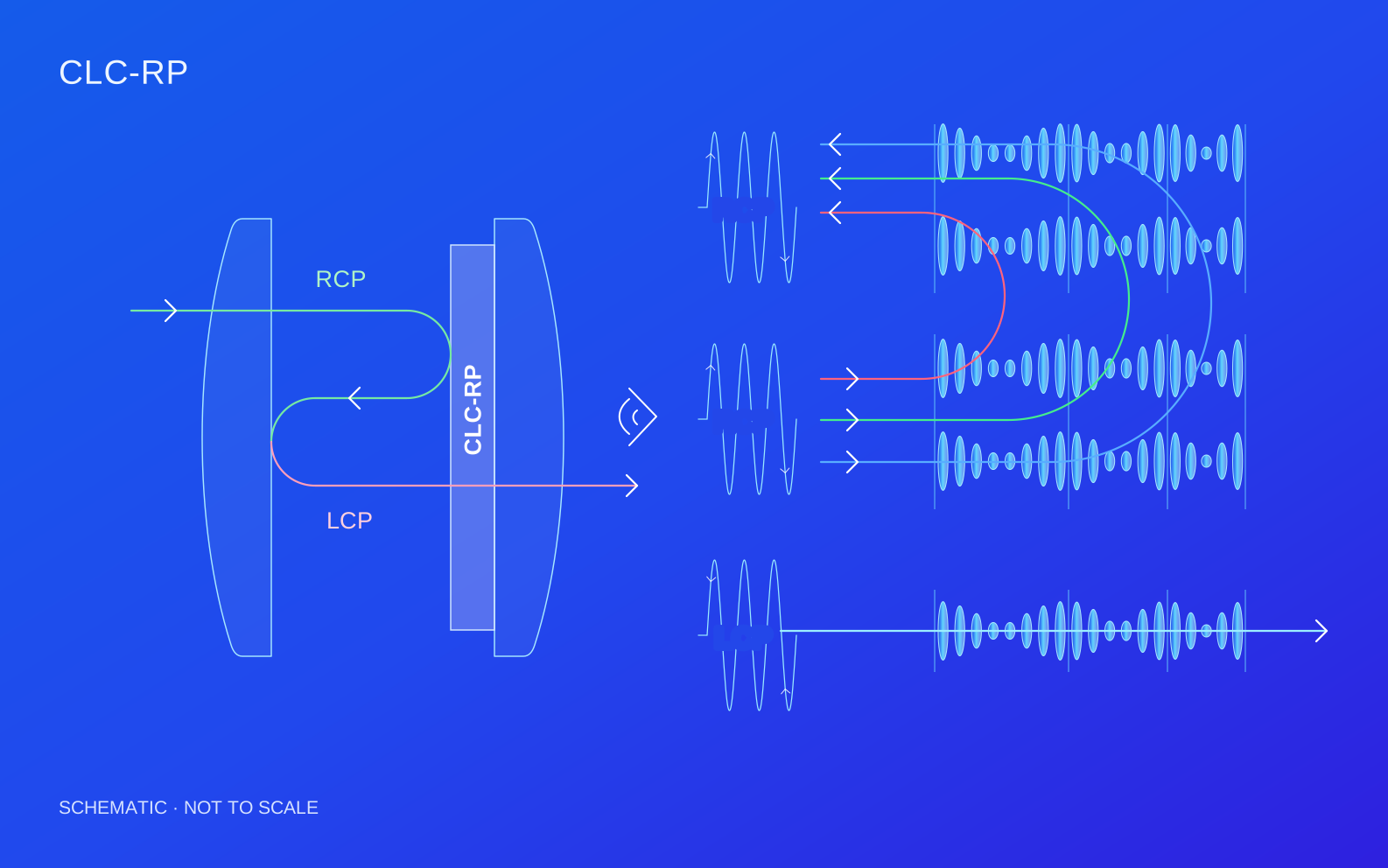
| RCP / LCP | Right-/Left-handed Circular Polarization | Polarization-state labels in the drawing, rather than film model names. Use a consistent propagation and viewing convention. |
|---|
Reflective polarizers and circular-polarization reflecting films can have different scope. Check polarization selectivity and reflection band.
01 / HOW IT WORKS
Device principles & design approach
Cholesteric helix and selective reflection
A cholesteric director rotates periodically along the helix axis, forming a one-dimensional anisotropic optical structure. Within the reflection band, a matching polarization component undergoes selective Bragg reflection while the other mainly transmits. Handedness labels require an explicit propagation and viewing convention, used consistently throughout the system.
Pitch, birefringence and reflection band
For an ideal positive-birefringence structure with uniform pitch and near-normal incidence along the helix axis, mean refractive index and pitch mainly set the band position; birefringence influences bandwidth. Pitch variation, thickness, interfaces, absorption and angles affect real films. This approximation does not apply unchanged to arbitrary curvature or large incidence angles.
λc ≈ n̄p; Δλ ≈ (ne − no)p
p is helix pitch; n̄ is the mean refractive index, and n_e and n_o are extraordinary and ordinary indices in the relevant spectral range.
Intrinsic circular-polarization selection and optical design
The CLC helix directly provides circular-polarization-selective reflection without an additional quarter-wave plate for that selection function. In pancake optics, this can reduce the number of combined retarder and reflective-polarizer layers. Polarization conversion elsewhere is defined by the light-engine output, folding sequence and complete optical path. Assessment still includes spectrum, angle, polarization leakage and multiple reflections.
Reflective wavefronts, curved coatings and validation
LC orientation and helical structure can encode reflection phase so the film carries a target wavefront, co-designed with the substrate surface and reflection geometry. Direct curved-surface coating can reduce separate elements and flat-waveplate lamination constraints. Curvature, sag, thickness and stress affect local response; validation includes spectra, polarization selectivity, wavefront and spatial uniformity.
Principle references+
Background: LC polarization holography, geometric phase and volume diffraction ↗
02 / TECHNICAL BENEFITS
Characteristics & benefits
01No additional quarter-wave plate required
The CLC-RP helix intrinsically provides circular-polarization-selective reflection and transmission, without an additional quarter-wave plate for that selection function. This can reduce the number of combined retarder and reflector layers. Polarization conversion elsewhere is configured for the actual optical path.
Wavefront functionality in the reflective film
Spatial LC orientation and structural design can combine circular-polarization selection with a target reflected wavefront in the same film. Co-design with the substrate surface can reduce separate optical elements and provide additional freedom for optical power, aberration control and optical layout.
Curved-surface coating with fewer shape constraints
Direct film fabrication on a curved substrate integrates the reflective polarizer with a lens or another optical surface. Its circular-polarization selection does not depend on an additional flat waveplate, reducing waveplate lamination constraints on shape and curvature. Curvature, sag and film uniformity are included in process design.
Separate reflected and transmitted channels
Selective reflection within the designed band provides film-based polarization folding and optical-energy management.
Designable spectral response
Pitch, thickness and structural distribution provide variables for band position, bandwidth and spatial response.
03 / DESIGN INPUTS
Design variables & assessment conditions
These are the inputs for a design assessment, not fixed product specifications. Numerical performance, test conditions and delivery scope are confirmed for the agreed design.
Custom design requirements| Parameter | Requirements to discuss |
|---|
| Reflection band / spectrum | Specify the desired reflection and transmission spectra. |
|---|
| Handedness / incidence angle | Confirm polarization convention and angular conditions. |
|---|
| Substrate / surface profile | Assess substrate, curvature, sag and coating or integration conditions. |
|---|
| Optical-stack integration | Evaluate the film with the intended optical stack. |
|---|
04 / APPLICATIONS
Applications & system integration
01
VR pancake optical folding
Use an intrinsically circular-polarization-selective reflecting layer in a folded path, reducing waveplates added for that selection function and co-designing lenses and reflecting interfaces.
Design conditionsMatch spectrum, angle distribution and handedness convention; check leakage and stray light.
02
Curved polarizing-film and wavefront integration
Fabricate the reflective polarizing film directly on a curved substrate with specified curvature and sag, combining surface shape and the target reflected wavefront.
Design conditionsValidate thickness, stress, wavefront and local response across the curved surface.
03
Selective reflection spectra
Develop modules with different polarization or spectral requirements in reflection and transmission.
Design conditionsVerify the specified wavelength and angle range rather than assuming invariant selectivity.
Suitability depends on the complete optical system and must be assessed against your operating conditions.
05 / COMMON QUESTIONS
Device characteristics & selection
Why can CLC-RP omit an additional quarter-wave plate?+
The cholesteric helix itself provides circular-polarization-selective reflection and transmission. That selection function does not require an added quarter-wave plate. Any other polarization conversion needed in the system is determined by the complete optical path.
Can CLC-RP replace any reflective polarizer?+
Replacement requires assessment of polarization, spectrum, angle and the complete optical stack. It should not be treated as a universal drop-in replacement.
How is curved-surface compatibility assessed?+
Provide the surface profile, substrate, sag, clear aperture and optical targets. We evaluate these with film processing and integration requirements.