
Choosing an electrically tunable focusing approach starts with four questions: how large the aperture is, how fast it must be, whether the light is polarized, and whether the focus must be continuously tunable or only needs a few positions. For phone and industrial cameras that need a fairly long travel and have no polarization requirement, a voice coil motor (VCM) moving a lens group is the most mature option. Compact modules with apertures of a few millimeters that can accept a response of tens of milliseconds suit electrowetting liquid lenses, while systems with apertures of about 10 mm that need millisecond-scale continuous focus scanning, such as microscope Z-scanning, commonly use elastic-membrane liquid lenses. Systems whose light source is itself polarized, with a small aperture and a requirement for no moving parts and a thin profile, suit continuous focusing with GRIN liquid crystal lenses. For VR/AR near-eye displays with large apertures that only need sub-millisecond switching between a few focal planes, PB liquid crystal lenses are currently one of the few feasible solutions.
These conclusions come from a few physical laws, not from the specifications of a particular product. This article first explains what quantity each of the five approaches changes, then compares them item by item: optical power and aperture, response time, power consumption, gravity and vibration, lifetime, polarization, wavefront quality and dispersion, temperature, and thickness. Finally it gives a scenario-based selection method and a parameter checklist. Where no reliable literature supports a performance figure, this article gives only an order of magnitude or a qualitative comparison; manufacturer specifications quoted in reviews are not treated as conclusions. No electrically tunable lens currently meets all the ideal requirements on size, stability, tuning range, speed, aperture, voltage and power consumption at the same time [1], so selection is essentially a trade-off among these specifications.
This article follows the conventions of the series: optical power in diopters, D (that is, ); the clear aperture is written ; the object-side vergence is also in D. "Electrically tunable zoom" is a common expression, but what a single tunable element does in a system is usually focusing, not optical zoom; the difference between the two and how liquid crystal lenses are integrated into a system are covered in What Is a Liquid Crystal Tunable Lens? Principles, Types and System Integration and are not repeated here. A detailed comparison between the two types of liquid crystal lenses is given in PB Lenses vs. GRIN Liquid Crystal Lenses: Principles, Performance and Selection.
How the five approaches change the focus
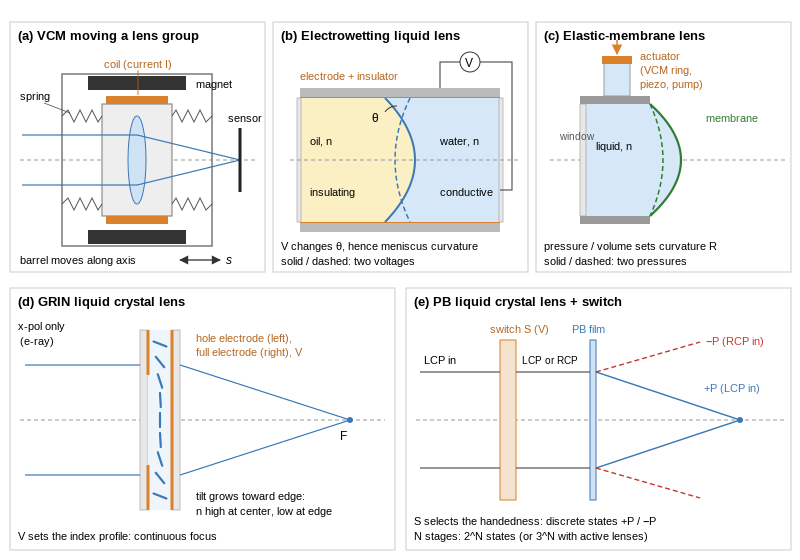
A voice coil motor moving a lens group
A voice coil motor consists of a permanent magnet and a coil. When current flows, the coil experiences a Lorentz force proportional to the current, ( is the force constant), which pushes the lens barrel along the optical axis; a spring provides the restoring force, and at equilibrium the displacement is , where is the spring stiffness. What it changes is the image distance; the optical power of the lenses themselves is unchanged. Holding a position requires a continuous current: the miniature VCM reported by Liu and Lin uses a Hall element for closed-loop position control and needs about 17 mA to hold a lens group weighing about 200 mgw in the vertical direction, about 75% less than the holding current required by conventional VCMs in phone cameras at that time [2].
Moving the lens group by is equivalent to changing the object-side vergence by [3]; the derivation of this conversion is given in What Is a Liquid Crystal Tunable Lens? Principles, Types and System Integration. A VCM with a travel therefore has an equivalent vergence range of about .
Example. For a 4.5 mm phone lens to refocus from infinity to 10 cm, the image plane must move back by μm.
Electrowetting liquid lenses
A tube contains two immiscible liquids with different refractive indices, one conducting and one insulating, and their interface is the refracting surface. The electrode on the tube wall is covered by an insulating layer; when a voltage is applied, the effective interfacial tension between the conducting liquid and the wall decreases and the contact angle changes accordingly. This is electrowetting. Before contact angle saturation, the contact angle and the voltage obey the Lippmann–Young relation [4]
where is the contact angle without voltage, and are the relative permittivity and thickness of the insulating layer, and is the interfacial tension between the two liquids.
How the contact angle becomes optical power follows from geometry. In a tube of radius the interface is a spherical cap, whose angle with the wall is the contact angle, and the radius of curvature of the cap is . The optical power of a single refracting surface equals the index difference across it divided by its radius of curvature [3], so
is the index difference between the two liquids; when crosses the interface changes from convex to concave and the optical power changes sign. Berge and Peseux used this principle to make a voltage-controlled variable-focus lens [5]. Kuiper and Hendriks sealed two liquids in a tube with an inner diameter of 3 mm; the optical power could be controlled between and D, the interface changed smoothly from convex to concave, and no hysteresis was observed [6].
Example. The salt water and oil used by Kuiper and Hendriks have refractive indices of about 1.38 and 1.55 [6], so . At a 3 mm aperture, setting (a hemispherical interface) in the expression above gives an upper limit of about 113 D, the same order of magnitude as the reported D.
Elastic-membrane liquid lenses
An elastic-membrane liquid lens seals a transparent liquid behind an elastic membrane and uses an actuator to change the pressure or volume of the liquid in the chamber, so that the membrane bulges or sags. For a plano-convex shape the optical power is [3], where is the refractive index of the liquid and the radius of curvature of the membrane. As early as 1993, Sugiura and Morita analyzed and built a liquid-filled lens consisting of a solid plate, a ring spacer and an elastic membrane: it focuses by changing the liquid volume, its theoretical surface is a paraboloid, and it is approximately spherical in the central region [7]. The fluidic adaptive lens of Zhang et al. needs no moving lens elements and has a shortest focal length of 41 mm, corresponding to F/2.05 [8], which converts to an aperture of about 20 mm.
The actuator can be a pump, a piezoelectric element or an electromagnetic structure [1]. In the tunable lens used by Grewe et al. in a two-photon microscope, a ring driven by a voice coil presses the outer part of the membrane, changing the curvature of the spherical membrane surface in the center [9]. Such lenses still have actuators and moving parts; only the object being moved changes from a lens group to a liquid.
GRIN liquid crystal lenses
A gradient-index (GRIN) liquid crystal lens has a liquid crystal layer of uniform thickness and uses its electrode structure to produce an electric field that varies with radius, so that the molecular tilt varies with radius and the refractive index differs between the center and the edge [10]. The optical path difference comes from an index difference rather than a thickness difference, and the upper limit of the optical power of a single-layer lens is , where is the maximum optical path difference the liquid crystal layer can provide. Changing the voltage changes the profile and the focal length continuously; but the voltage only changes the refractive index of the extraordinary wave, so a single-layer device acts on only one linear polarization component. The principle and electrode structures are explained in GRIN Liquid Crystal Lenses: How Voltage Tunes Focal Length Continuously, and device forms can be seen on the GRIN gradient-index liquid crystal lens page.
PB liquid crystal lenses
A PB liquid crystal lens is a liquid crystal film that satisfies the half-wave condition, with the in-plane molecular orientation arranged according to the lens phase; through the geometric phase it gives optical powers of and to left- and right-handed circularly polarized light respectively. The optical power is fixed by the alignment pattern, and the voltage can only change "with which handedness the light enters" or "whether the lens acts at all": a passive PB film combined with a polarization switch switches between ; an active PB lens loses its effect under a high voltage, and its optical power becomes 0 [11]. A cascade of stages gives or discrete focal states. The principle is explained in PB Lens Principles: How Geometric Phase Liquid Crystal Lenses Switch Focal Length Electrically, and related devices on the liquid crystal tunable lens (LC-ETL) page.
Power range and aperture: three scaling laws
The five approaches depend on aperture in different ways, and this is the first item to check in selection.
Interface-curvature type: . Electrowetting and elastic-membrane lenses both refract at a single curved surface whose radius of curvature cannot be smaller than half the aperture (a hemisphere), so the upper limit is for an electrowetting lens and for a plano-convex elastic-membrane lens. Doubling the aperture halves the limit. This is only a geometric limit: the actual range is also limited by contact angle saturation [4], membrane strain and aberrations that grow with curvature.
GRIN liquid crystal lenses: . The optical path difference required at the edge of the lens relative to the center is , which grows with the square of the aperture, while the optical path difference the liquid crystal layer can provide is fixed at . Doubling the aperture reduces the limit to a quarter.
PB liquid crystal lenses: . Because the phase is wrapped modulo , the optical power is not limited by the optical path difference of the liquid crystal layer; what limits it is the minimum period at the edge, : the smaller the F-number, the closer the period gets to the film thickness and the harder it is to make the alignment accurate. Gao et al. reported a thin-film PB lens at F/2.1 with an efficiency above 97% [12]. For a given minimum F-number, the limit likewise falls as .
VCM: equivalent vergence . A VCM does not change optical power; its "range" is set by its travel. If the F-number of the lens group is fixed, , and for a fixed travel the equivalent range also falls with the square of the aperture; maintaining the range requires a longer travel, and the moving mass grows rapidly with the size of the lens group. This is why VCMs are most effective with small lenses.
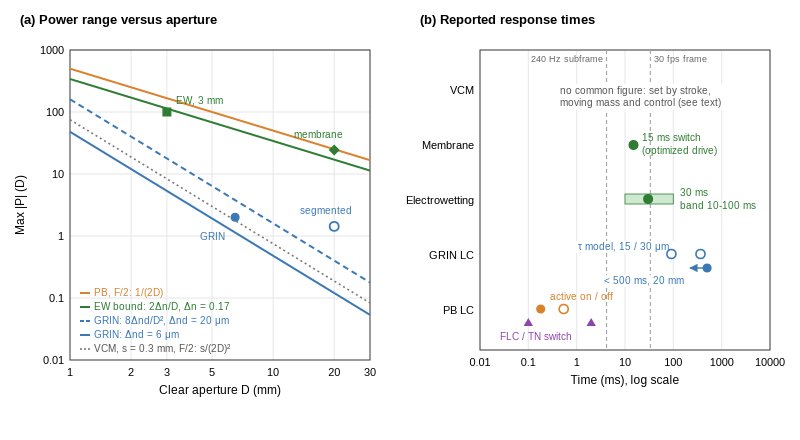
The laws in Figure 2(a) can be used directly to rule out approaches.
Example. A GRIN liquid crystal lens with an optical path difference of 6 μm has an upper limit of about 5.3 D at a 3 mm aperture, about 0.48 D at 10 mm, and only about 0.12 D at 20 mm; an electrowetting lens with the same 3 mm aperture has a limit of about 113 D. For a VCM with 0.3 mm travel and an F/2 lens group (example values), the equivalent range is about 12 D at a 2.5 mm aperture (5 mm focal length) and about 0.75 D at a 10 mm aperture (20 mm focal length).
The two liquid crystal lens data points in the figure show how real devices relate to the limits. The modal-control lens of Naumov et al. has an aperture of 6.5 mm and can focus collimated light at 0.5 m [13]; by this requires an optical path difference of about 10.6 μm, which falls between the two GRIN lines. The 20 mm lens system of Jamali et al. lies above the limit for a continuous profile because it uses a segmented phase profile that resets the optical path difference at several radii, while remaining continuously tunable within each segment; the system consists of two liquid crystal lenses with opposite alignment, a +0.75 D glass lens and a linear polarizer, with an optical power range of about 0.06–1.43 D [14]. The resets come at the cost of diffraction at the segment boundaries; ways for GRIN lenses to circumvent the square law are described in GRIN Liquid Crystal Lenses: How Voltage Tunes Focal Length Continuously.
Response time: what limits each approach
VCM: a mass–spring system. The lens barrel and spring form a second-order system with natural angular frequency . After a step drive the barrel oscillates; the settling time depends on damping and the control method, and closed-loop position control can speed up settling and improve repeatability. The experimental characterization by Liu et al. of a miniature Hall-sensor closed-loop VCM shows that positioning repeatability, dynamic tilt angle, response speed and power consumption must be optimized together [15]. Because travel, moving mass and control methods vary widely, this article does not give a single response value for VCMs.
Elastic-membrane lenses: resonances of actuator plus liquid. Grewe et al. measured two mechanical resonances of a voice-coil-driven tunable lens near 300 Hz and 600 Hz; the step response first oscillates rapidly and then slowly approaches the target. After optimizing the drive signal, the switching time between two layers was about 15 ms, with an axial positioning error below 1 μm over 2000 back-and-forth switches [9].
Electrowetting lenses: liquid inertia and viscosity. Berge and Peseux reported a typical response time of 0.03 s [5]. A review points out that the response time of electrowetting lenses is generally on the order of 10–100 ms and, for a given aperture, depends on the density, viscosity and interfacial tension of the liquids; the larger the aperture, the more liquid must move, and the slower both the response and the recovery; the drive waveform must trade off speed against suppression of interface oscillations [1]. Zhan et al. also note that droplet inertia fundamentally limits the speed of electrowetting lenses, more noticeably at large apertures [16].
GRIN liquid crystal lenses: the square of the cell thickness. When the voltage is removed, the molecules return by elastic restoring forces, and the orientational relaxation time is about , where is the rotational viscosity and the splay elastic constant. Substituting the minimum cell thickness needed to reach optical power , ,
where is the index difference actually available. At fixed optical power, the response time grows with the fourth power of the aperture. This is the fundamental reason GRIN lenses are at a disadvantage in large-aperture, fast applications. The turn-on direction can be sped up with higher voltage; driving methods are described in Electrical Control of Liquid Crystal Devices: Response Time, Polarization Switches and Cascaded Switching.
Example. With (example value), the relaxation time is about 91 ms for a 15 μm liquid crystal layer, about 365 ms for 30 μm, and about 1.04 ms for 1.6 μm.
PB liquid crystal lenses: thin layers or polarization switches. A PB lens only needs to satisfy the half-wave condition, so the liquid crystal layer is only one or two micrometers thick. Lee et al. reported a 1.6 μm active PB lens with a turn-on time of 0.18 ms and a turn-off time of 0.54 ms; the switching speed of a passive PB film is set by the polarization switch, about 2 ms for a thin TN polarization rotator and about 0.1 ms for a ferroelectric liquid crystal [11].
Put these values on the time scales of applications: one frame of 30 fps video is about 33 ms, and each subframe of a four-plane multifocal display at 60 Hz per plane is about 4.2 ms. Only thin-layer devices like PB lenses fit within a subframe; elastic-membrane lenses can switch layers within a few frames; GRIN lenses at the hundred-millisecond level suit refocusing on changeover, slow tracking and static compensation.
Power consumption and driving
Whether holding a focal state consumes power depends on whether the actuation is by "force" or by "electric field".
- VCM. A spring-type structure needs a continuous current to counter the spring force and gravity, as the holding current data of Liu and Lin show [2]. There is a further trade-off: the stiffer the spring, the higher , the faster the response and the smaller the gravitational sag (see the next section), but the same travel requires a larger holding force and the current increases accordingly.
- Elastic-membrane lenses. Electromagnetic actuation likewise needs a continuous current. The driver of Grewe et al. outputs 0–200 mA at up to 5 V [9]; a review considers that electromagnetically actuated fluidic lenses have a large tuning range but are thicker, heavier and less energy-efficient [1]. Piezoelectric actuation, by contrast, is electrostatic and low in power consumption, but its small displacement limits the aperture [1].
- Electrowetting lenses. Electrically, they are a capacitor with leakage. Berge and Peseux reported a dissipated power of a few milliwatts [5]; the drive voltage is generally on the order of 10–100 V, and prolonged DC causes charge accumulation and hysteresis, so AC drive is commonly used [1].
- Liquid crystal lenses. The liquid crystal layer is approximately a capacitor and consumes energy only when charging and discharging; the drive voltage is generally on the order of 10–100 V with low power consumption [1], and segmented-phase designs can work below 5 V [14].
Example. A GRIN liquid crystal cell with a 4 mm aperture, a 20 μm liquid crystal layer and a relative permittivity of 10 has a capacitance of about 55.6 pF; driven at 10 V and 1 kHz AC, its charging and discharging power is about 5.6 μW. An active PB lens with a 20 mm aperture and a 1.6 μm cell gap has a capacitance of about 17.4 nF, giving about 0.85 mW at 7 V and 1 kHz. Neither figure includes losses in the transparent electrodes and high-resistance layers or in the drive circuit itself; large-aperture, thin cells have large capacitance, and the current capability of the drive circuit must be designed accordingly.
Gravity, vibration and mounting orientation
Mechanical and liquid approaches are sensitive to orientation, for different reasons.
VCM: sag of the suspended mass. With a lens group mass and spring stiffness , turning the lens from horizontal to vertical shifts the equilibrium position by . This shift does not depend on the mass; it is determined solely by the natural frequency.
Example. At a natural frequency of 100 Hz the sag is about 24.8 μm, at 50 Hz about 99 μm, and at 200 Hz about 6.2 μm (example values). For a 4.5 mm lens, an image plane shift of 24.8 μm corresponds to a vergence error of about 1.2 D; at F/1.8 with a permissible blur spot of 2 μm, the vergence tolerance is about D. The difference between lens-up and lens-down orientations is twice as large again.
An open-loop VCM must therefore rely on position feedback (such as a Hall sensor) or image-based closed-loop focusing to remove the effect of orientation; shocks and vibrations are also transmitted directly to the suspended lens group.
Electrowetting lenses: interfacial tension against gravity. The ratio of gravity to interfacial tension can be estimated by the Bond number , where is the density difference between the two liquids. For the interface stays spherical.
Example. With and (example values), at a 3 mm aperture and about 0.61 at 10 mm; when the density difference is reduced to , these drop to about 0.0006 and 0.006.
The Bond number grows with the square of the aperture, which is one reason electrowetting lenses usually have apertures of only a few millimeters. Kuiper and Hendriks matched the densities of the two liquids, so the meniscus stays perfectly spherical regardless of orientation and is quite insensitive to external vibrations and shocks [6]. A review also lists sensitivity to shock, vibration and gravitational sag as limitations of electrowetting lenses, and avoiding gravitational sag requires density-matched liquids [1].
Elastic-membrane lenses: hydrostatic pressure gradient. When the lens is mounted vertically, the hydrostatic pressure of the liquid increases by about from top to bottom across the aperture, so the membrane surface is no longer axially symmetric. Calculations by Sugiura and Morita show that the effect of gravity can be neglected when the pump pressure exceeds 30 times the additional gravitational pressure at the bottom of the lens [7].
Example. With a liquid density of , Pa at a 10 mm aperture, so by the criterion above the pump pressure should be at least about 2.9 kPa; at a 20 mm aperture it should be about 5.9 kPa.
For a thin membrane dominated by membrane tension, the chamber pressure is approximately proportional to the membrane curvature, so the state near zero optical power has the lowest pressure and, paradoxically, the largest relative effect of gravity. Zhao et al. point out that a membrane of uniform thickness has an inherent conflict between spherical aberration and gravity sensitivity; they designed a membrane whose thickness varies with radius, allowing a 3 mm lens to reach the diffraction limit near its nominal focal length in any orientation, but this optimal range covers only focal lengths of about 7.2–8.8 mm [17].
Liquid crystal lenses: no moving mass. GRIN and PB liquid crystal lenses have no displaced parts and no macroscopic flow of material in operation; their optical performance is independent of mounting orientation, and vibration affects the optical path only through the mounting structure. This is their most definite advantage over mechanical and liquid approaches.
Lifetime and reliability
This article found no lifetime data that can be compared across the five approaches; the following only describes where the failure mechanisms of each come from.
- VCM. The moving parts are subject to spring fatigue and guide wear, and shocks can deform the suspension.
- Electrowetting lenses. Prolonged DC causes charge to accumulate in the insulating layer, impairing reversibility and causing hysteresis [1]; the device of Kuiper and Hendriks showed no hysteresis when switching between convex and concave [6].
- Elastic-membrane lenses. There is an actuator and a stressed membrane; over 2000 back-and-forth switches, Grewe et al. observed the fluorescence intensity drop to about 95%, presumably due to slight thermal drift of the lens, but the positioning error remained below 1 μm [9].
- Liquid crystal lenses. There are no moving parts. The main risk is electrochemical: residual ions in the liquid crystal migrate under any DC component and accumulate at the interfaces, causing image sticking and, over the long term, degradation, so the drive voltage must contain no DC component [18]. A passive PB film is a cured liquid crystal polymer and has no electrodes of its own. For laser use, the damage threshold and absorption must also be considered; see Dynamic Laser Focusing with Liquid Crystal Lenses: Focus Control in Processing and Inspection.
When selecting a device, ask the supplier for test data on cycle life, high- and low-temperature storage and operation, shock and vibration, and recheck them against your own operating conditions.
Polarization requirements
A VCM moves a glass lens group, and the liquids and elastic membranes in liquid lenses are isotropic, so all three are polarization independent and can be used directly for imaging with natural light.
A single-layer GRIN liquid crystal lens focuses only the linear polarization component whose polarization lies in the plane in which the molecules rotate; the other component passes unchanged and forms a defocused background at the image plane. There are three remedies: add a polarizer, losing at least half the light; use two liquid crystal lenses with orthogonal alignment, each handling one component, as Lin and Chen demonstrated in an electrically tunable-focusing liquid crystal lens without a polarizer [19]; or use the lens in a system whose light source is itself polarized. A review points out that polarizer-free, continuously tunable liquid crystal lenses currently have apertures of roughly no more than the 10 mm order [1]. The 20 mm system of Jamali et al. mentioned above uses a linear polarizer, and the authors note that adding two more liquid crystal lenses with orthogonal alignment would remove the polarizer [14].
A PB liquid crystal lens gives optical powers of opposite sign to the two handednesses [11], so it needs circularly polarized input of a single handedness; linearly polarized or unpolarized light contains both handednesses and is split equally into a converging and a diverging part. Displays such as LCD and LCoS output linearly polarized light, which a quarter-wave plate converts losslessly into circular polarization; unpolarized sources must be polarized first.
Wavefront quality, aberrations and dispersion
Wavefront quality. In the VCM approach, image quality is determined by the glass lens group; what needs attention is tilt of the lens group during motion, and the dynamic tilt angle is one of the characterization metrics of VCMs [15]. The image quality of an electrowetting lens depends on the radial symmetry of the meniscus; Kuiper and Hendriks measured an RMS optical path difference of about 0.027 wavelengths with an interferometer, far below the requirement of the diffraction limit [6]. The surface of an elastic-membrane lens is a paraboloid that is close to spherical only in the central region [7]; its spherical aberration varies with curvature and is coupled to its gravity sensitivity [17]. The phase profile of a GRIN liquid crystal lens changes with voltage: the phone-camera liquid crystal lens of Galstian et al. keeps spherical aberration below at optical powers up to 10 D [20]; thermal fluctuations of the liquid crystal orientation also scatter light, producing haze that reduces contrast [21]. The wavefront of a PB lens is determined by the alignment pattern; the F/2.1 lens of Gao et al. has an efficiency above 97% [12]; the part of the light that does not meet the half-wave condition leaks into the zero order and forms ghost images, and in cascades the efficiencies multiply stage by stage [11].
Dispersion. A VCM introduces no additional chromatic aberration, and the existing achromatic design of the lens remains unchanged. The dispersion of a liquid lens comes from the liquids, has the same sign as glass, and can be included in an achromatic design together with fixed lenses; Kuiper and Hendriks built an achromatic miniature camera module on this basis [6]. The optical power of a GRIN liquid crystal lens is proportional to the available index difference, and liquid crystal birefringence is larger at short wavelengths, so its dispersion also has the same sign as glass. A PB lens is a diffractive element with optical power , opposite in sign to glass and large in magnitude: with 589 nm as reference, a 25 D PB lens varies by about 7.22 D between 486 nm and 656 nm, compared with about 0.39 D for an N-BK7 lens of the same power [11].
Example. A 2 D PB lens designed at 550 nm varies in optical power by about 0.73 D between 450 and 650 nm. In broadband imaging, PB lenses should therefore handle switching of no more than a few diopters; methods for compensating the chromatic aberration are described in Achromatic Liquid Crystal Lenses: How Chromatic Aberration in Diffractive Lenses Is Corrected.
Temperature
GRIN liquid crystal lenses are the most sensitive. The birefringence of liquid crystals decreases with rising temperature, and decreases faster the closer the temperature is to the clearing point [22]; the rotational viscosity increases at low temperature, slowing the response markedly [18].
Example. Using Haller's approximation with and K (example values), the relative temperature coefficient of birefringence at 25 °C is about . If the tilt profile is unchanged, a GRIN lens working at 3 D loses about 0.12 D of optical power when heated by 10 K.
The focal length of PB liquid crystal lenses does not change with temperature. The optical power is set by the alignment pattern; temperature changes only the phase retardation and thus the efficiency.
Example. If at 25 °C, after the birefringence drops by the coefficient above over 10 K, , and the zero-order leakage is about 0.40%. The focal state positions are unchanged; only the ghost images increase slightly.
Liquid lenses. The two liquids used by Kuiper and Hendriks both have temperature coefficients of refractive index of about , so their index difference is almost unchanged and the effect on focal length is small; the remaining change can be compensated by fine adjustment of the voltage [6]. An elastic-membrane lens has only one liquid refracting against air; if the liquid's is of the same order and (example value), the relative change in optical power is about ; in addition, thermal expansion of the liquid changes the chamber volume and pressure. A review points out that liquid lenses are sensitive to temperature fluctuations and that open-loop driving requires compensation with a temperature sensor [1].
VCM. The main effects are thermal deformation of the barrel and holder and changes in coil resistance; closed-loop control can absorb most of them.
Thickness and volume
- VCM. The module must accommodate the magnet, coil, springs and travel; the miniature VCM of Liu and Lin measures 6.5 mm × 6.5 mm × 4 mm [2].
- Electrowetting lenses. An axial length is needed to hold the two liquids and the curved interface.
- Elastic-membrane lenses. The lens itself can be very thin, but the actuator occupies lateral or axial space, and electromagnetically actuated designs are thicker and heavier overall [1].
- GRIN liquid crystal lenses. Flat-plate devices whose thickness is set mainly by the substrates. A GRIN liquid crystal lens with an aperture of about 10 mm reported by Lin et al. uses 0.4 mm glass substrates [21]; the 20 mm lens of Jamali et al. is less than 2 mm thick [14].
- PB liquid crystal lenses. The liquid crystal film is only micrometers thick; the lens of Gao et al. is about 2.26 μm thick [12]; in cascades, the thickness comes mainly from the substrates of each stage and the polarization switches.
A qualitative comparison table
| Dimension | VCM moving a lens group | Electrowetting liquid lens | Elastic-membrane liquid lens | GRIN liquid crystal lens | PB liquid crystal lens |
|---|---|---|---|---|---|
| Quantity changed | Lens group position (image distance) | Liquid–liquid interface curvature | Membrane curvature | Index profile | Sign or presence of geometric phase |
| Continuous or discrete | Continuous | Continuous | Continuous | Continuous | Discrete focal states |
| Range and aperture | Equivalent about , limited by travel | Limit about | Limit about | Limit | , minimum F-number limited by period |
| Response | Depends on travel, mass and control | Generally 10–100 ms | About 15 ms after drive optimization (one example) | Hundreds of milliseconds, growing as | Sub-millisecond to a few milliseconds |
| Power to hold a focal state | Continuous current needed | Capacitive, milliwatt level | Continuous current for electromagnetic drive | Capacitive, very low | Capacitive, very low |
| Gravity and vibration | Sag , shocks go directly to the lens group | Needs density-matched liquids | Hydrostatic gradient, needs sufficient pressure | No moving mass | No moving mass |
| Reliability concerns | Spring fatigue and wear | Charge accumulation and hysteresis | Long-term stability of actuator, membrane and liquid | Ionic degradation from DC components | Same as left; passive film has no electrodes |
| Polarization | Independent | Independent | Independent | Single layer acts on one linear polarization only | Needs circular polarization of one handedness |
| Wavefront quality | Set by the lens group; watch dynamic tilt | Can be far better than the diffraction limit when the interface is symmetric | Spherical aberration varies with curvature, affected by gravity | Varies with voltage, scattering haze | Efficiency determines zero-order ghosts |
| Dispersion | None added | Liquid dispersion, achromatic design possible | Liquid dispersion | Same sign as glass | Power proportional to wavelength, opposite sign to glass |
| Temperature | Thermal deformation of the structure | Small effect when both liquid indices change together | Refractive index and thermal expansion | Large changes in birefringence and viscosity | Focal length unchanged; efficiency and speed change |
| Thickness and volume | Module including travel space | Axial length to hold the liquids | Thicker once the actuator is included | Flat plate, mostly substrates | Thin film; cascades add substrates |
The entries in the table are qualitative summaries based on physical mechanisms and the literature cited above, and specific devices may deviate; numbers hold only where their source and conditions are stated above.
Selection by scenario
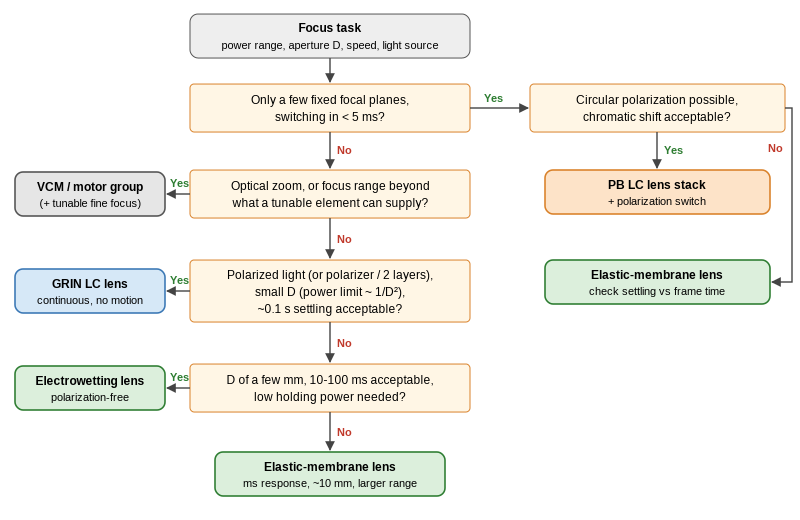
For selection, first convert the requirements into four numbers: the required optical power or vergence range (D), the clear aperture at the element's location, the allowable switching or settling time, and the polarization and spectrum of the light. Then eliminate options following Figure 3. The scenarios are discussed below.
Phone cameras and industrial cameras. The VCM is the conventional focusing actuator in phone cameras [2]; its travel covers focusing from infinity to macro, it is polarization independent and it is the default choice; its weaknesses are orientation sensitivity and a continuous holding current. Electrowetting lenses have been demonstrated in miniature camera modules [6] and suit applications with apertures of a few millimeters where removing the moving lens group is desired. Liquid crystal lenses have also been demonstrated for phone-camera autofocus [20], but imaging with natural light requires orthogonal double layers, and video focusing places high demands on speed. Industrial cameras often use polarized or narrowband illumination, and their working distances are often a few known values; these conditions favor liquid crystal lenses: GRIN lenses for continuous adjustment, and PB lenses can be considered for fast switching among a few fixed working distances, the latter still being an application potential. See Liquid Crystal Lens Autofocus: Electrical Focusing in Cameras and Machine Vision.
Microscope Z-scanning. Voice-coil-driven elastic-membrane tunable lenses have been validated in two-photon microscopy: layer switching in about 15 ms and a maximum axial range of about 0.7 mm with a 40×, NA 0.8 water-immersion objective [9]; they are the first choice when polarization-independent, continuous and fast scanning is needed. The optical path difference required by a liquid crystal lens grows with the scan span and with the square of the numerical aperture, so it is not fast enough for high-NA, large-span scanning; placing a single-layer GRIN lens in the excitation path where only linearly polarized laser light passes, or using a PB lens to switch among a few focal planes, are application potentials. See Microscope Z-Scanning with Liquid Crystal Lenses: Fast Focusing Without Moving the Objective.
Endoscopes and miniature imaging. The distal-tip aperture is only of the millimeter order, leaving no room for motors and travel; small apertures fall exactly in the region where the optical power limit of liquid crystal lenses is generous, and they also suit electrowetting lenses. Chen and Lin switched a liquid crystal lens among three discrete optical powers in an endoscope system, giving a range of clearly observable object distances of 12.4–76.4 mm [23]. White light and fluorescence are both unpolarized, so liquid crystal approaches must account for the thickness and drive channels of a double-layer structure; body temperature and packaging also need specific consideration. See Liquid Crystal Lenses for Endoscope Focusing: Electrical Focus Control in Miniature Imagers.
VR/AR near-eye displays. Near-eye lenses are large-aperture elements; the optical power and speed of GRIN lenses both fall sharply with aperture, and the liquid inertia of electrowetting lenses is also more noticeable at large apertures [16]. Displays output polarized light, and multifocal displays require switching within millisecond subframes, which is exactly the strength of PB lenses: a prototype has used two active PB lenses with optical powers of 0.5 D and 1.5 D to obtain four equally spaced focal planes [16]. For optical see-through AR, real-world light is unpolarized, and the lens must also leave the see-through path unchanged; large-aperture GRIN lenses are better suited to slow vision correction, such as the 20 mm lens of Jamali et al. for presbyopia correction [14]. See Solving the Vergence–Accommodation Conflict (VAC) in VR: Varifocal and Multifocal Liquid Crystal Lenses and Varifocal AR Glasses and Vision Correction with Liquid Crystal Lenses.
Laser processing and optical inspection. Lasers are polarized, narrowband sources, so the polarization and dispersion costs of liquid crystal lenses are smallest; the limits come from power handling, absorption in transparent electrodes and thermal lensing. When continuous tracking below a millisecond is needed, motor- or voice-coil-driven dynamic focusing modules and elastic-membrane lenses are still more suitable; for slow focus compensation in linearly polarized laser beams or switching among a few working distances, the thin profile and absence of moving parts of liquid crystal lenses are more valuable. See Dynamic Laser Focusing with Liquid Crystal Lenses: Focus Control in Processing and Inspection.
Research optics and compact instruments. Experimental setups mostly use polarized lasers, and focusing is often a slow fine adjustment in collimation, beam waist positioning and fiber coupling; a single-layer GRIN lens can replace translation stages and manual mounts and facilitates closed-loop automation; elastic-membrane lenses are used when fast scanning is needed, and spatial light modulators or deformable mirrors when higher-order aberration correction is needed. See Liquid Crystal Lenses in Research Optics: Fiber Coupling, Beam Focusing and Wavefront Correction.
Selection parameter checklist
When requesting quotes from suppliers or reviewing a design, the following checklist can be used.
- Optical power range. How many diopters on the positive and negative sides, and whether zero must be crossed; for PB lenses, the number, spacing and symmetry of focal states. Convert the working distance range into vergence and divide by the system's depth of field to estimate the number of focal states needed.
- Clear aperture and position. Whether the element sits at the stop or in front of the lens, and what clear aperture is actually needed; for GRIN lenses, recheck against .
- Definition of response time. Turn-on or turn-off direction, 10%–90% or settling to within the depth of focus; the difference between large and small steps; whether overdrive is needed.
- Repeatability and hysteresis. The error when the same command returns to the same focal plane, and whether approaching from opposite directions differs.
- Polarization and spectrum. The polarization state of the incident light, the operating band and bandwidth; for liquid crystal approaches, the polarization architecture (single layer, orthogonal double layer, circular polarization) and the optical power difference within the band.
- Wavefront quality. RMS wavefront error or MTF at each focal state, off-axis field performance, and for PB lenses the efficiency and zero-order leakage.
- Transmittance and stray light. Including absorption in transparent electrodes, interface reflections, scattering haze and ghost images.
- Driving. Voltage, frequency, current and power consumption, whether a continuous current is needed to hold a focal state; number of channels; whether temperature sensing and lookup-table compensation are needed.
- Environment. Operating and storage temperature ranges, temperature coefficients, mounting orientation, shock and vibration ratings.
- Lifetime. Number of cycles and long-term drift; damage threshold and absorption in laser applications.
- Size and weight. Thickness, outer diameter and the space occupied by the actuator.
Among these parameters, the aperture, optical power and driving method often need to be designed jointly for the specific system. When the aperture, focal states or driving scheme of a liquid crystal lens need to be customized to system parameters, see custom development service.
Demonstrated capabilities and application potential
The following capabilities have been demonstrated in the literature:
- VCMs with Hall-sensor closed loops are used for phone-camera focusing, with measured data on holding current and positioning repeatability [2][15].
- Electrowetting liquid lenses achieve hysteresis-free tuning from to D at a 3 mm aperture and have been built into miniature camera modules [6].
- Voice-coil-driven elastic-membrane lenses achieve layer switching in about 15 ms and an axial range of about 0.7 mm in two-photon microscopy [9].
- GRIN liquid crystal lenses have achieved autofocus in phone cameras with spherical aberration below at 10 D [20]; a 20 mm segmented-phase liquid crystal lens achieves a response below 500 ms and on-axis diffraction-limited performance within a 5 mm aperture [14].
- Active PB lenses switch in under a millisecond [11], and PB lens stacks have been used in multifocal near-eye display prototypes [16].
The following are still application potentials that require experimental validation in specific systems:
- Using PB lenses for fast switching among a few fixed working distances in machine vision.
- Multi-layer switching with a single-layer liquid crystal lens in the excitation path of a two-photon microscope.
- Large-aperture, polarization-independent, fast and continuously tunable liquid crystal lenses; aperture, speed and polarization are still hard to achieve together.
References
[1] L. Chen, M. Ghilardi, J. J. C. Busfield, F. Carpi. Electrically tunable lenses: a review. Frontiers in Robotics and AI, 8: 678046, 2021. DOI: 10.3389/frobt.2021.678046
[2] C.-S. Liu, P. D. Lin. A miniaturized low-power VCM actuator for auto-focusing applications. Optics Express, 16(4): 2533, 2008. DOI: 10.1364/OE.16.002533
[3] E. Hecht. Optics, 5th ed. Pearson, 2017. ISBN 978-0-13-397722-6
[4] F. Mugele, J.-C. Baret. Electrowetting: from basics to applications. Journal of Physics: Condensed Matter, 17(28): R705–R774, 2005. DOI: 10.1088/0953-8984/17/28/R01
[5] B. Berge, J. Peseux. Variable focal lens controlled by an external voltage: An application of electrowetting. The European Physical Journal E, 3(2): 159–163, 2000. DOI: 10.1007/s101890070029
[6] S. Kuiper, B. H. W. Hendriks. Variable-focus liquid lens for miniature cameras. Applied Physics Letters, 85(7): 1128–1130, 2004. DOI: 10.1063/1.1779954
[7] N. Sugiura, S. Morita. Variable-focus liquid-filled optical lens. Applied Optics, 32(22): 4181, 1993. DOI: 10.1364/AO.32.004181
[8] D.-Y. Zhang, V. Lien, Y. Berdichevsky, J. Choi, Y.-H. Lo. Fluidic adaptive lens with high focal length tunability. Applied Physics Letters, 82(19): 3171–3172, 2003. DOI: 10.1063/1.1573337
[9] B. F. Grewe, F. F. Voigt, M. van 't Hoff, F. Helmchen. Fast two-layer two-photon imaging of neuronal cell populations using an electrically tunable lens. Biomedical Optics Express, 2(7): 2035–2046, 2011. DOI: 10.1364/BOE.2.002035
[10] Y.-H. Lin, Y.-J. Wang, V. Reshetnyak. Liquid crystal lenses with tunable focal length. Liquid Crystals Reviews, 5(2): 111–143, 2017. DOI: 10.1080/21680396.2018.1440256
[11] Y.-H. Lee, G. Tan, T. Zhan, Y. Weng, G. Liu, F. Gou, F. Peng, N. V. Tabiryan, S. Gauza, S.-T. Wu. Recent progress in Pancharatnam–Berry phase optical elements and the applications for virtual/augmented realities. Optical Data Processing and Storage, 3(1): 79–88, 2017. DOI: 10.1515/odps-2017-0010
[12] K. Gao, H.-H. Cheng, A. K. Bhowmik, P. J. Bos. Thin-film Pancharatnam lens with low f-number and high quality. Optics Express, 23(20): 26086–26094, 2015. DOI: 10.1364/OE.23.026086
[13] A. F. Naumov, M. Yu. Loktev, I. R. Guralnik, G. Vdovin. Liquid-crystal adaptive lenses with modal control. Optics Letters, 23(13): 992, 1998. DOI: 10.1364/OL.23.000992
[14] A. Jamali, D. Bryant, A. K. Bhowmick, P. J. Bos. Large area liquid crystal lenses for correction of presbyopia. Optics Express, 28(23): 33982–33993, 2020. DOI: 10.1364/OE.408770
[15] C.-S. Liu, S.-S. Ko, P.-D. Lin. Experimental characterization of high-performance miniature auto-focusing VCM actuator. IEEE Transactions on Magnetics, 47(4): 738–745, 2011. DOI: 10.1109/TMAG.2010.2103084
[16] T. Zhan, J. Xiong, J. Zou, S.-T. Wu. Multifocal displays: review and prospect. PhotoniX, 1(1): 10, 2020. DOI: 10.1186/s43074-020-00010-0
[17] P. Zhao, Ç. Ataman, H. Zappe. Gravity-immune liquid-filled tunable lens with reduced spherical aberration. Applied Optics, 55(28): 7816–7823, 2016. DOI: 10.1364/AO.55.007816
[18] D.-K. Yang, S.-T. Wu. Fundamentals of Liquid Crystal Devices, 2nd ed. John Wiley & Sons, 2014. ISBN 978-1-118-75200-5. DOI: 10.1002/9781118751992
[19] Y.-H. Lin, H.-S. Chen. Electrically tunable-focusing and polarizer-free liquid crystal lenses for ophthalmic applications. Optics Express, 21(8): 9428–9436, 2013. DOI: 10.1364/OE.21.009428
[20] T. Galstian, O. Sova, K. Asatryan, V. Presniakov, A. Zohrabyan, M. Evensen. Optical camera with liquid crystal autofocus lens. Optics Express, 25(24): 29945–29964, 2017. DOI: 10.1364/OE.25.029945
[21] Y.-H. Lin, W.-C. Cheng, H.-S. Chen, Y.-J. Wang, X. Liang. Orientation fluctuation in liquid crystal lenses. Journal of Optical Microsystems, 3(4): 041204, 2023. DOI: 10.1117/1.JOM.3.4.041204
[22] J. Li, S. Gauza, S.-T. Wu. Temperature effect on liquid crystal refractive indices. Journal of Applied Physics, 96(1): 19–24, 2004. DOI: 10.1063/1.1757034
[23] H.-S. Chen, Y.-H. Lin. An endoscopic system adopting a liquid crystal lens with an electrically tunable depth-of-field. Optics Express, 21(15): 18079–18088, 2013. DOI: 10.1364/OE.21.018079