
The fundamental difference between PB lenses and GRIN liquid crystal lenses is where the phase comes from. A PB lens (geometric phase lens) produces a geometric phase from the spatial distribution of the in-plane orientation of liquid crystal molecules. It needs only a single micrometer-scale half-wave film, and the phase wraps automatically every , so large apertures and high optical power are achievable, but the focal length can only switch between discrete focal states fixed at the design stage. A GRIN liquid crystal lens (gradient-index liquid crystal lens) uses an electric field to modulate the spatial distribution of the effective refractive index, producing a propagation phase; its focal length is continuously tunable with voltage, but the liquid crystal layer must supply the entire optical path difference the lens requires, so aperture, optical power and response time constrain one another.
The principles of the two lenses are derived separately in PB Lens Principles: How Geometric Phase Liquid Crystal Lenses Switch Focal Length Electrically and GRIN Liquid Crystal Lenses: How Voltage Tunes Focal Length Continuously. This article does not repeat those derivations. Instead, it compares the two lenses with a common set of parameters: phase mechanism, focusing mode, the quantitative trade-off among aperture, optical power and response time, polarization requirements, dispersion and stray light, and aberrations and wavefront quality. It ends with selection recommendations by application and a discussion of how the two can be combined.
Notation follows the rest of this series: optical power in diopters (D); aperture diameter , liquid crystal layer thickness and birefringence . Circular handedness follows the convention of Hecht's Optics [1]: looking against the direction of propagation, a counterclockwise-rotating field is left-handed (LCP) and a clockwise-rotating one is right-handed (RCP); left-handed light converges in a PB lens.
Two kinds of phase: geometric phase and propagation phase
A PB lens is a liquid crystal film of uniform thickness that satisfies the half-wave condition, with phase retardation ; for and nm, μm. The in-plane azimuthal angle of the molecules varies with radius; left-handed light acquires a geometric phase , right-handed light acquires , and the output handedness is flipped [2]. The phase is encoded by the "orientation" of the molecules, not by "how much optical path" the light travels. When the molecules rotate by they return to the original arrangement and the geometric phase changes by exactly , so phase wrapping needs no additional structure, and the thickness of the liquid crystal layer is independent of the optical power.
The liquid crystal layer of a GRIN liquid crystal lens also has uniform thickness, but the in-plane orientation of the molecules does not change. The electrode structure produces an electric field that varies with radius, so the molecular tilt varies with radius, and light polarized along the alignment direction experiences an effective index that varies accordingly. The phase comes from differences in the optical path and is a propagation phase; this planar gradient-index structure is one of the main types of liquid crystal lens [3]. A propagation phase does not wrap by itself: whatever optical path difference is needed between the edge and the center, the liquid crystal layer must supply all of it.
The comparison is clearest on a common scale. A paraxial lens needs an optical path difference of at the edge of the aperture relative to the center; expressed as a number of wavelengths, this is
A PB lens wraps by once per zone, so the number of zones is , and the liquid crystal layer only has to provide the phase within one period; a GRIN lens does not wrap, so the maximum optical path difference that its liquid crystal layer can provide must be at least .
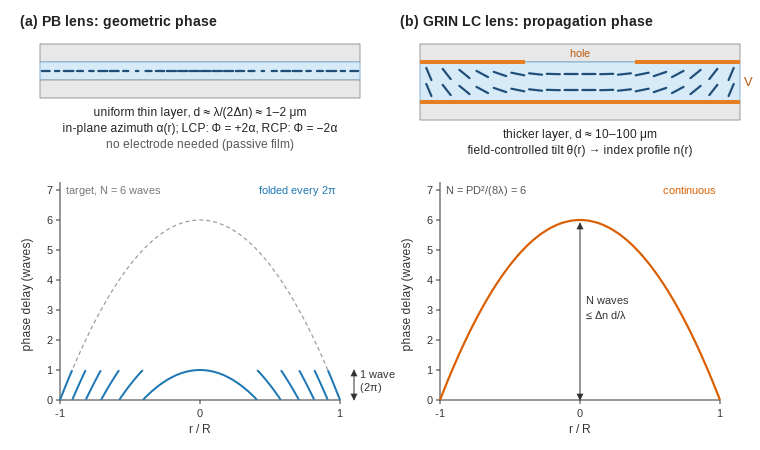
Example. For a lens with a 20 mm aperture and 2 D of optical power, at 550 nm, and the edge optical path difference is 100 μm. As a PB lens it is F/25 with a minimum local period of about 27.5 μm, and the liquid crystal layer is still about 1.8 μm thick; a GRIN lens with a continuous profile and would need a 500 μm liquid crystal layer.
This difference determines almost all of the performance differences that follow. The liquid crystal thickness of a GRIN lens grows with , which leads to the limits on optical power and response time; the thickness of a PB lens is fixed, but the sign of its phase depends on the input handedness, which leads to polarization requirements, and the fact that "the phase is fixed in radians" also brings diffractive dispersion.
Focusing mode: discrete focal states versus continuous tuning
The optical power of a PB lens is written into its orientation pattern, and voltage can change only two things: the handedness with which light enters the lens, and whether the lens acts at all [2]. This yields several basic units: a passive PB film plus a polarization switch, which switches between and ; an active PB cell, in which a high voltage makes the molecules stand upright and the lens action disappears, switching between and 0; and a polarization switch plus an active lens, which gives three focal states, , 0 and , in a single stage. After cascading stages, the number of focal states is or respectively, and choosing the optical powers of the stages in binary or ternary steps gives equally spaced focal states [2]. The combination rules and the effect of handedness flipping are covered in PB Lens Principles: How Geometric Phase Liquid Crystal Lenses Switch Focal Length Electrically and in Electrical Control of Liquid Crystal Devices: Response Time, Polarization Switches and Cascaded Switching.
It should be stressed that intermediate voltages on an active PB lens do not give intermediate optical powers. At an intermediate voltage, lies between and 0; a fraction of the light acquires the full optical power , while the rest is not modulated at all. The result is a superposition of two foci, not a lens with an intermediate focal length. The focal states of a PB lens are therefore genuinely discrete.
A GRIN lens instead writes its function into the tilt distribution. Voltage changes the tilt continuously, the focal length can stop at any value within the tuning range, and the intermediate states are still complete lenses. The price is that the relationship between voltage and optical power is nonlinear, and the aberrations change with the drive state, so each target optical power usually needs its own calibrated set of drive voltages. If the phase of a GRIN lens is made diffractive, folding back at every full wavelength, the liquid crystal layer can be reduced to a few micrometers: Li et al. built a switchable diffractive lens with a 5 μm nematic liquid crystal layer and a circular array of electrodes, with a drive voltage below 2 V (rms), a response time below 1 s and diffraction efficiency above 90% [4]. But the zones of such a lens are fixed by the electrode pattern, its optical power can only switch among a few values, and it acquires the same diffractive dispersion as a PB lens.
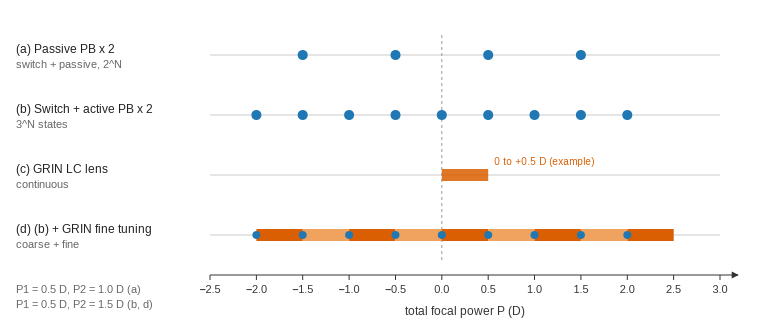
What discrete versus continuous means for a system depends on where the focal plane needs to stop. A multifocal display needs only a few fixed depths: Zhan et al. used stacked switchable PB lenses to produce multiple real focal planes for each eye [5]; according to their later review, the prototype used two active PB lenses of 0.5 D and 1.5 D to obtain four equally spaced focal planes, with a 240 Hz LCD providing 60 Hz images for each depth [6]. Autofocus, on the other hand, must bring the focus onto any object distance, and discrete steps are sufficient only if half the step spacing is smaller than the system's depth of focus.
Example. Following the estimate in What Is a Liquid Crystal Tunable Lens? Principles, Types and System Integration, a lens with an 8 mm focal length, F/2 and an allowed blur spot of 2 μm has an object-side vergence tolerance of about 0.0625 D. To cover 0 to 4 D with discrete steps, the step spacing cannot exceed about 0.125 D, which requires at least 33 focal states. A three-state cascade needs 4 stages (81 focal states), i.e. 4 polarization switches and 4 active PB lenses, 8 liquid crystal cells in total. If each cell has 98% efficiency, only about 85% remains in the main beam. The same requirement can be met by a single continuously tunable lens.
Aperture, optical power and response time
GRIN lenses: the optical path difference budget decides everything
The upper limit of optical power for a single-layer GRIN liquid crystal lens, as derived in GRIN Liquid Crystal Lenses: How Voltage Tunes Focal Length Continuously, is
The relaxation time constant of liquid crystal reorientation is , where is the rotational viscosity and is the splay elastic constant [7]. If the usable index difference is (equal to in the ideal case), the minimum thickness needed to reach optical power is , and substituting into the relaxation time gives
The response time grows with the square of the optical power and the fourth power of the aperture. This is the core trade-off of GRIN lenses: doubling the aperture at the same optical power makes the relaxation time 16 times longer. The switch-on direction can be sped up by raising the voltage, but the switch-off direction relies only on elastic restoration and is usually the bottleneck [7].
Example. Take and (ideal lower bound). For 1 D of optical power: a 2 mm aperture needs 2.5 μm and ms; 5 mm needs 15.6 μm and about 99 ms; 10 mm needs 62.5 μm and about 1.6 s; 20 mm needs 250 μm and about 25 s. In practice the usable is smaller than , so both the required thickness and the time will be larger.
These numbers show that GRIN lenses are not slow at apertures of a few millimeters or less; the problem lies in large apertures. The ways around this limit all "fold" the optical path difference to some degree: splitting one thick liquid crystal layer into several thin cells, or resetting the phase at certain radii. A numerical analysis by Li et al. showed that both approaches improve speed and optical power [8]; Jamali et al. used a segmented phase profile to achieve continuous tuning from 1.5 D to 0 D over a 20 mm aperture, with a response time below 500 ms and a drive voltage below 5 V, reaching the on-axis diffraction limit within a 5 mm aperture [9]. Estimated with a continuous profile, the same specifications would require a liquid crystal layer of about 375 μm. The cost of segmentation is the phase discontinuity at the reset boundaries, which produces diffractive stray light (see GRIN Liquid Crystal Lenses).
PB lenses: F-number rather than thickness
The optical power of a PB lens can be written as , where . It is not limited by the optical path difference; the limit comes from how fine the orientation pattern can be. The minimum local period at the edge is , determined only by the F-number and the wavelength. When approaches the thickness of the liquid crystal layer, the elasticity of the liquid crystal makes it hard for the orientation to follow the designed pattern closely, and efficiency drops (see PB Lens Principles). High-efficiency devices at low F-numbers have been reported: Gao et al. fabricated a PB lens about 2.26 μm thick at F/2.1 with efficiency above 97% [10]; Kim et al. reported a geometric phase lens at F/2.3 with 99% diffraction efficiency at 633 nm [11]. On the large-aperture side, the ultra-broadband PB lens used by Zhan et al. for chromatic aberration correction in VR is 2 inches in diameter and designed for a focal length of 60 cm at 532 nm (about 1.7 D) [12]. The review by Lee et al. also lists large diopter changes and large apertures among the advantages of PB lenses [2].
The response time of a PB lens is independent of aperture and optical power and depends only on the thin liquid crystal layer or the polarization switch. The 1.6 μm active PB lens reported by Lee et al. has a turn-on time of 0.18 ms at 7 Vrms and a relaxation time of 0.54 ms after the voltage is removed; in passive configurations, a thin TN polarization rotator takes about 2 ms and a ferroelectric liquid crystal polarization rotator about 0.1 ms [2].
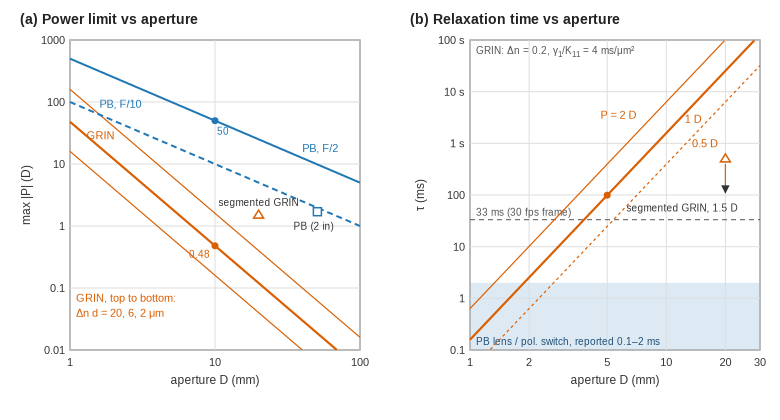
The two sets of curves in Figure 3(a) have different slopes: the GRIN limit falls as , the PB limit only as . Setting them equal gives the crossover aperture .
Example. With μm and an F/2 PB lens, the crossover aperture is only about 96 μm. At a 10 mm aperture, the GRIN limit is about 0.48 D while an F/2 PB lens can reach 50 D, a difference of about a hundredfold; at a 2 mm aperture, the GRIN limit is 12 D and the response time falls between a few and a few tens of milliseconds, which is already enough for many small-aperture focusing applications.
So when comparing the two lenses, the single most useful quantity is the optical path difference budget , i.e. the required focusing range times the square of the aperture, divided by 8. When it is only a few micrometers (small aperture, small range), both the thickness and the speed of a GRIN lens are acceptable; when it reaches tens to hundreds of micrometers (large aperture), a continuous GRIN lens is no longer realistic, and the choice is either a PB lens or folding the GRIN optical path difference by segmentation, multiple layers or similar methods.
Polarization requirements
A PB lens requires circularly polarized input of a single handedness. Linearly polarized light can be decomposed into equal left- and right-handed components: the former acquires and becomes right-handed, the latter acquires and becomes left-handed, each carrying half the intensity; unpolarized light is split equally as well, except that the two parts are mutually incoherent [2]. If the source itself emits linearly polarized light, such as an LCD or LCoS display or a laser, a quarter-wave plate converts it to circular polarization without loss; if the source is unpolarized, polarizing it loses at least half the light. Giving opposite optical powers to the two handednesses is an intrinsic property of the geometric phase, so practical systems always convert the input into a single handedness before it enters the lens; the output handedness is flipped, and downstream polarization elements must be designed for the flipped handedness.
A single-layer GRIN liquid crystal lens acts on only one linear polarization component. In a planar cell, the extraordinary wave polarized along the alignment direction experiences an index that varies with tilt, while the orthogonal ordinary wave always experiences , as if passing through a uniform plate. Sato's 1979 liquid crystal lens made use of this: the focal length varied between for the extraordinary wave and for the ordinary wave [13]. With unpolarized input, half the light is focused and the other half keeps the original focal length. The solution is to stack two liquid crystal layers with mutually perpendicular alignment and identical profiles, so that each of the two orthogonal components passes through the same lens once. In 1985, Sato et al. stacked two identical liquid crystal Fresnel lenses with perpendicular optic axes and obtained a variable-focus liquid crystal lens with a transmittance of about 80% or more [14]. The cost is double the thickness, interfaces and drive channels, and the two layers must be matched; otherwise the two polarization components have different focal lengths.
The consequences of the "wrong" polarization also differ. In a PB lens, light entering with the wrong handedness acquires , a difference of from the target focal plane; in a single-layer GRIN lens, light with the wrong polarization acquires 0, a difference of . Both form a defocused background on the image plane, but in the PB lens this light is more severely defocused and more widely spread.
| Polarization condition | PB lens | Single-layer GRIN liquid crystal lens |
|---|---|---|
| Required input | Circular polarization of a single handedness | Linear polarization along the alignment direction |
| Linearly polarized input | Split equally into and parts | Fully focused when aligned; otherwise only the projected component is focused |
| Circularly polarized input | All of it acquires or | Half is focused, half is unaffected |
| Unpolarized input | At least 50% lost to polarizing | At least 50% lost to polarizing, or use orthogonal double layers |
| Output polarization | Handedness flipped | Polarization state essentially unchanged |
This table matters especially when the two are combined: a PB lens outputs circularly polarized light, and if that light enters a single-layer GRIN lens directly, only half of it is focused; a quarter-wave plate is needed in between, or an orthogonal double-layer GRIN lens must be used instead.
Dispersion, efficiency and stray light
Focal-length dispersion in opposite directions
The geometric phase written into a PB lens is independent of wavelength in radians. The same phase corresponds to a more strongly curved wavefront at longer wavelengths, so the optical power is proportional to wavelength, ; the equivalent Abbe number is about , opposite in sign to that of glass and very small in magnitude. The derivation and comparison are in Achromatic Liquid Crystal Lenses: How Chromatic Aberration in Diffractive Lenses Is Corrected.
The optical power of a GRIN lens, , contains no wavelength, so its dispersion comes only from the material: if the tilt distribution is independent of wavelength, is approximately proportional to . Liquid crystal birefringence is larger at short wavelengths [7], so the optical power is larger at short wavelengths, in the same direction as glass. Quantitatively, the birefringence dispersion can be described by Wu's single-band model , where is a material-dependent coefficient and is the mean resonance wavelength [15]. Applying the definition of the Abbe number directly, the equivalent Abbe number of a GRIN lens is
It is independent of , the film thickness and the aperture, and is determined only by .
Example. Assume two cases, nm and 250 nm (example values); the single-band model gives and 6.4. For a 2 D lens, the difference in optical power between the F and C lines is about 0.18–0.31 D for GRIN, about 0.58 D for PB (with opposite sign), and about 0.03 D for an N-BK7 glass lens (Abbe number 64.17, see Achromatic Liquid Crystal Lenses: How Chromatic Aberration in Diffractive Lenses Is Corrected). Between 450 and 650 nm, a 2 D PB lens varies from 1.64 D to 2.36 D.
So the chromatic aberration of a GRIN lens is smaller than that of a PB lens but much larger than that of glass. The reason is that the optical power of a glass lens is proportional to (about 0.5), whereas that of a GRIN lens is proportional to (a difference on the order of 0.2), whose relative dispersion is much larger. The two lenses have dispersion of opposite sign, so in combination they can partially cancel: from the achromatic condition [1], using a GRIN lens to compensate a PB lens requires a GRIN optical power about 1.9–3.2 times that of the PB lens, with the same sign. But as soon as the GRIN optical power changes, the compensation condition no longer holds, so this can only reduce chromatic aberration near one focal state. In broadband systems, the more reliable approach is still to let the PB lens carry only a small optical power, or to use the achromatic structures discussed in Achromatic Liquid Crystal Lenses.
Different sources of efficiency loss and stray light
The stray light of a PB lens comes mainly from zero-order leakage. The half-wave condition holds only at the design wavelength; away from it, the unconverted fraction is . This light carries no optical power, and its handedness is not flipped.
Example. For a single-layer PB lens with and a film thickness of 1.83 μm, the conversion efficiency is 100% at 550 nm, about 88.3% at 450 nm and about 94.3% at 650 nm.
The way to broaden the bandwidth is to introduce a multilayer structure with opposite twist senses through the thickness: Oh and Escuti used a double-twist structure to achieve broadband, high-efficiency diffraction from polarization gratings [16], and calculations by Lee et al. for double-twist PB elements show that the efficiency can exceed 98% within 450–650 nm [2]. The leaked light has a different handedness from the main beam and can be filtered out with a circular analyzer; in a cascade the efficiencies multiply stage by stage, and residual errors of the polarization switches produce ghost images at the wrong focal states (see PB Lens Principles and Electrical Control of Liquid Crystal Devices: Response Time, Polarization Switches and Cascaded Switching).
A GRIN lens with a continuous profile has no diffraction orders and therefore no zero-order leakage: light is either focused or (the wrong polarization component) not focused. Its losses and stray light come from elsewhere: half of unpolarized light, absorption in the transparent electrodes and reflections at multiple interfaces, and scattering haze caused by thermal fluctuations of the liquid crystal orientation. Lin et al. analyzed the origin of this haze, reduced it by about 50% by choosing the elastic constants and the electric field, and improved the imaging contrast [17]. GRIN lenses with segmented phase or diffractive profiles introduce diffractive stray light again at the reset boundaries and phase steps.
Aberrations and wavefront quality
The phase of a PB lens is determined by its orientation pattern and is fixed once the lens is made. The exact non-paraxial phase can be written directly at the design stage (see PB Lens Principles), so the wavefront of each focal state is well defined at the design wavelength and does not drift with drive voltage. Its aberrations have two main sources. One is a mismatch between the exposure wavelength and the operating wavelength: the orientation pattern usually records an exact spherical-wave phase for the exposure wavelength, and at a different operating wavelength the fourth-order term no longer matches, producing spherical aberration; Luo et al. pointed out that this mismatch causes severe aberration at small F-numbers and proposed correcting it by exposing with two template lenses of different focal lengths [18]. The other is oblique incidence: the effective retardation of the liquid crystal layer and the local grating condition vary with the angle of incidence, so efficiency and focal position change across the field.
The phase of a GRIN lens is determined jointly by the electric field distribution and the elasticity of the liquid crystal; it does not automatically become parabolic, and its aberrations also change with drive voltage. A set of voltages can give the best profile only near one optical power, and additional degrees of freedom such as multiple voltages and drive frequency are needed for correction (see GRIN Liquid Crystal Lenses). During switching, the molecules at each point rotate with their own time constants, and the phase profile of the transient state is not necessarily parabolic either.
The fabrication accuracy required for the two lenses can be compared with the Maréchal criterion: when the RMS residual wavefront error is no more than , the Strehl ratio is about 0.8 and imaging is close to the diffraction limit [19].
Example. The edge optical path difference of a GRIN lens is wavelengths, so an absolute accuracy of corresponds to of the total optical path difference: about 0.65% for (an optical path difference of about 6 μm at 550 nm), and the larger is, the stricter the requirement. The phase error of a PB lens is twice the orientation-angle error, so corresponds to a phase error of rad, i.e. an RMS orientation-angle error of about , independent of . This is only an estimate for random errors; the efficiency and stray light of a PB lens impose separate requirements on orientation accuracy.
Temperature also affects the two differently. The refractive indices and birefringence of liquid crystals vary with temperature [20]. The optical power of a GRIN lens is proportional to and drifts directly with it; the optical power of a PB lens is determined only by the geometry of the orientation pattern, and temperature changes only , and thus the efficiency.
Example. Suppose a temperature change lowers by 3%. The optical power of a 2 D GRIN lens drifts by about 0.06 D, already comparable to the tolerance of about 0.0625 D for the 8 mm, F/2 lens in the earlier section; the optical power of a PB lens designed as a half-wave plate is unchanged, and its conversion efficiency drops from 100% to about 99.8%.
Selection by application
The conclusions above are summarized below.
| Comparison | PB lens | GRIN liquid crystal lens |
|---|---|---|
| Phase origin | Geometric phase, set by in-plane orientation, wraps automatically at | Propagation phase, index profile set by tilt, does not wrap |
| Focusing mode | Discrete focal states: , /0; cascades give or | Continuously tunable within its range |
| Liquid crystal thickness | About half-wave, 1–2 μm, independent of optical power | At least , often tens of micrometers |
| Optical power limit | , limited by minimum period; about F/2 reported | , falling with the square of the aperture |
| Response time | Sub-millisecond to a few milliseconds, independent of aperture | Grows as ; millisecond level possible at small apertures |
| Polarization requirement | Circular polarization of a single handedness; output handedness flipped | A single layer acts on one linear polarization component; orthogonal double layers can be polarization-independent |
| Dispersion | Diffractive dispersion, , equivalent Abbe number about | Follows , same direction as glass, weaker than PB |
| Main stray light | Zero-order leakage, residual switch errors | Unmodulated polarization component, scattering haze, reset boundaries |
| Temperature effect | Optical power unchanged, efficiency drops slightly | Optical power drifts with |
The liquid crystal tunable lens (LC-ETL), represented by the PB geometric phase lens, and the GRIN gradient-index liquid crystal lens therefore suit different scenarios. The table below gives recommendations by application, with the reasoning drawn from the quantitative relationships above; specific specifications still need to be confirmed by measurement in the actual system.
| Application | Main requirements | Recommendation | Reasoning |
|---|---|---|---|
| VR/AR multifocal and varifocal displays | Eyepiece aperture of tens of millimeters, a few diopters, switching within a subframe | Cascaded PB lenses | At large apertures the optical power is not limited by optical path difference, and switching takes sub-milliseconds to milliseconds; displays emit polarized light, which converts to circular polarization without loss [2][6] |
| Camera and machine vision autofocus | Stop of a few millimeters, a few diopters, must reach any object distance, natural light | GRIN lens (orthogonal double layer) | At small apertures the optical path difference budget is only a few micrometers, and continuous tuning suits closed-loop focusing; with unpolarized light, orthogonal double layers avoid polarizing loss |
| Microscope Z-scanning | Aperture of a few to over ten millimeters at the plane conjugate to the pupil; discrete planes or continuous scanning | PB lenses for fast multi-plane imaging; GRIN for continuous scanning with small pupils | PB speed is independent of aperture; GRIN is continuous but slows with aperture; in broadband fluorescence detection paths, PB dispersion must be accounted for |
| Endoscopes and miniature imaging | Aperture on the order of 1 mm, very limited space, continuous focusing | GRIN lens | At small apertures the optical power limit is high, the liquid crystal layer is thin and the response is fast; PB needs circular polarization, so unpolarized illumination must be polarized |
| Research optics (lasers) | Polarized, narrowband sources; switching between fixed focal positions or continuous fine tuning, wavefront correction | Either: PB for fast switching of large beams, GRIN for continuous fine tuning | Laser light is polarized and narrowband, so the polarization and dispersion costs of PB are smallest; a modally controlled GRIN lens is itself a kind of adaptive lens [21] |
Example. For a near-eye display, take an aperture of 40 mm at the eyepiece and a requirement of 1.5 D: a PB lens is F/16.7 with a minimum period of about 18.3 μm, easy to fabricate; a continuous GRIN lens with would need a liquid crystal layer about 1.5 mm thick, which is not realistic. For an endoscope with a 1 mm aperture needing 10 D: a continuous GRIN lens needs only about 6.3 μm of liquid crystal, with a relaxation time of about 16 ms.
How each scenario integrates the lens into the system is described in Solving the Vergence–Accommodation Conflict (VAC) in VR: Varifocal and Multifocal Liquid Crystal Lenses, Liquid Crystal Lens Autofocus: Electrical Focusing in Cameras and Machine Vision, Microscope Z-Scanning with Liquid Crystal Lenses: Fast Focusing Without Moving the Objective, Liquid Crystal Lenses for Endoscope Focusing: Electrical Focus Control in Miniature Imagers and Liquid Crystal Lenses in Research Optics: Fiber Coupling, Beam Focusing and Wavefront Correction; a comparison of liquid crystal lenses with liquid lenses and voice coil motors is in Electrically Tunable Focus Compared: Liquid Crystal Lenses, Liquid Lenses and Voice Coil Motors.
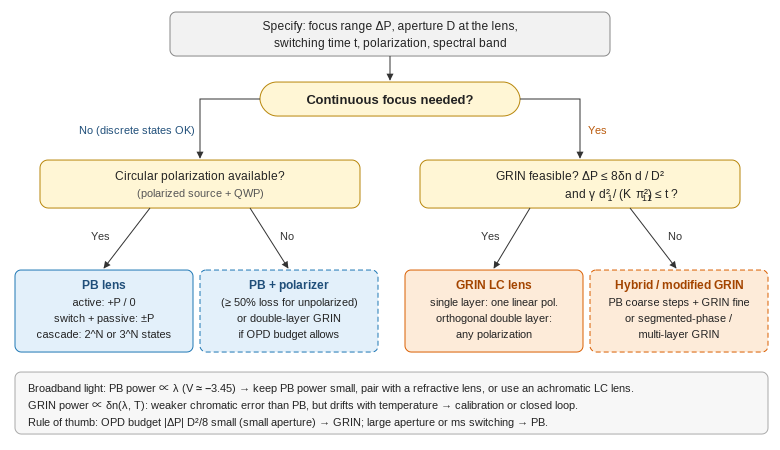
Figure 4 organizes the selection process as a flowchart. First determine the focusing range , the aperture at the lens, the allowed switching time , and the polarization and spectrum of the source; the first question is whether continuous focusing is required. If discrete focal states are acceptable, check whether circularly polarized input can be obtained. If continuous focusing is needed, use the two conditions and to check whether a single-layer GRIN lens is feasible; if not, consider segmented or multilayer GRIN, or the combined scheme in the next section.
Using the two together
The strengths of the two lenses are complementary, so they can be used in series: a PB lens cascade provides a few widely spaced, fast-switching discrete steps, and a GRIN lens fine-tunes continuously between the steps. The condition is that the continuous range of the GRIN lens is no smaller than the spacing of the PB steps, so that all steps plus fine tuning cover the whole range continuously, as in Figure 2(d).
Example. Two stages of "polarization switch plus active PB lens" (0.5 D and 1.5 D) give nine steps from to D at 0.5 D intervals. Adding a 0 to D GRIN lens over a 5 mm aperture requires an optical path difference of μm; with the liquid crystal layer is about 7.8 μm and the relaxation time about 25 ms, and with about 15.6 μm and 99 ms. The combination is continuously tunable from to D: large jumps are completed by the PB lenses in milliseconds, and the GRIN lens only handles fine tuning within half a diopter.
When combining them, the elements must be arranged along the polarization chain. One arrangement is: linearly polarized light first passes through a single-layer GRIN lens whose alignment matches it, then a quarter-wave plate converts it to circular polarization, and finally it enters the polarization switches and PB lenses. If instead the GRIN lens is placed after the PB lens, a quarter-wave plate is needed between them, or an orthogonal double-layer GRIN lens must be used. An unpolarized source also needs a polarizer at the very front. The efficiencies of all stages multiply and the number of interfaces grows; the zero-order leakage and switch errors of the PB part remain, and the optical power of the GRIN part still drifts with temperature; all of these must be included in the system budget. This is a combination concept based on the characteristics of the two devices; actual performance depends on the device implementation.
Another common combination is a liquid crystal lens plus a fixed refractive lens. Lee et al. combined an active PB lens with a 13 cm focal length and a biconvex lens with a 4 cm focal length, making the combined focal length switch between 3.06 cm and 4 cm [2]; GRIN lenses are likewise often paired with fixed lens groups, providing only an adjustable increment of optical power (see What Is a Liquid Crystal Tunable Lens? Principles, Types and System Integration). Designs involving specific apertures, optical power ranges and polarization chains need to be developed individually from the system parameters; see our custom development service.
References
[1] E. Hecht. Optics, 5th ed. Pearson, 2017. ISBN 978-0-13-397722-6
[2] Y.-H. Lee, G. Tan, T. Zhan, Y. Weng, G. Liu, F. Gou, F. Peng, N. V. Tabiryan, S. Gauza, S.-T. Wu. Recent progress in Pancharatnam–Berry phase optical elements and the applications for virtual/augmented realities. Optical Data Processing and Storage, 3(1): 79–88, 2017. DOI: 10.1515/odps-2017-0010
[3] Y.-H. Lin, Y.-J. Wang, V. Reshetnyak. Liquid crystal lenses with tunable focal length. Liquid Crystals Reviews, 5(2): 111–143, 2017. DOI: 10.1080/21680396.2018.1440256
[4] G. Li, D. L. Mathine, P. Valley, P. Äyräs, J. N. Haddock, M. S. Giridhar, G. Williby, J. Schwiegerling, G. R. Meredith, B. Kippelen, S. Honkanen, N. Peyghambarian. Switchable electro-optic diffractive lens with high efficiency for ophthalmic applications. Proceedings of the National Academy of Sciences, 103(16): 6100–6104, 2006. DOI: 10.1073/pnas.0600850103
[5] T. Zhan, Y.-H. Lee, S.-T. Wu. High-resolution additive light field near-eye display by switchable Pancharatnam–Berry phase lenses. Optics Express, 26(4): 4863–4872, 2018. DOI: 10.1364/OE.26.004863
[6] T. Zhan, J. Xiong, J. Zou, S.-T. Wu. Multifocal displays: review and prospect. PhotoniX, 1(1): 10, 2020. DOI: 10.1186/s43074-020-00010-0
[7] D.-K. Yang, S.-T. Wu. Fundamentals of Liquid Crystal Devices, 2nd ed. John Wiley & Sons, 2014. ISBN 978-1-118-75200-5. DOI: 10.1002/9781118751992
[8] L. Li, D. Bryant, T. Van Heugten, P. J. Bos. Speed, optical power, and off-axis imaging improvement of refractive liquid crystal lenses. Applied Optics, 53(6): 1124, 2014. DOI: 10.1364/AO.53.001124
[9] A. Jamali, D. Bryant, A. K. Bhowmick, P. J. Bos. Large area liquid crystal lenses for correction of presbyopia. Optics Express, 28(23): 33982, 2020. DOI: 10.1364/OE.408770
[10] K. Gao, H.-H. Cheng, A. K. Bhowmik, P. J. Bos. Thin-film Pancharatnam lens with low f-number and high quality. Optics Express, 23(20): 26086–26094, 2015. DOI: 10.1364/OE.23.026086
[11] J. Kim, Y. Li, M. N. Miskiewicz, C. Oh, M. W. Kudenov, M. J. Escuti. Fabrication of ideal geometric-phase holograms with arbitrary wavefronts. Optica, 2(11): 958–964, 2015. DOI: 10.1364/OPTICA.2.000958
[12] T. Zhan, J. Zou, J. Xiong, X. Liu, H. Chen, J. Yang, S. Liu, Y. Dong, S.-T. Wu. Practical chromatic aberration correction in virtual reality displays enabled by cost-effective ultra-broadband liquid crystal polymer lenses. Advanced Optical Materials, 8(2): 1901360, 2020. DOI: 10.1002/adom.201901360
[13] S. Sato. Liquid-crystal lens-cells with variable focal length. Japanese Journal of Applied Physics, 18(9): 1679–1684, 1979. DOI: 10.1143/JJAP.18.1679
[14] S. Sato, A. Sugiyama, R. Sato. Variable-focus liquid-crystal Fresnel lens. Japanese Journal of Applied Physics, 24(8A): L626, 1985. DOI: 10.1143/JJAP.24.L626
[15] S.-T. Wu. Birefringence dispersions of liquid crystals. Physical Review A, 33(2): 1270–1274, 1986. DOI: 10.1103/PhysRevA.33.1270
[16] C. Oh, M. J. Escuti. Achromatic diffraction from polarization gratings with high efficiency. Optics Letters, 33(20): 2287, 2008. DOI: 10.1364/OL.33.002287
[17] Y.-H. Lin, W.-C. Cheng, H.-S. Chen, Y.-J. Wang, X. Liang. Orientation fluctuation in liquid crystal lenses. Journal of Optical Microsystems, 3(4): 041204, 2023. DOI: 10.1117/1.JOM.3.4.041204
[18] Z. Luo, J. Zou, E. Zhao, Y. Rao, S.-T. Wu. Correcting the wavelength-induced phase deviation of Pancharatnam-Berry lenses. Optics Express, 30(20): 36644, 2022. DOI: 10.1364/OE.473679
[19] M. Born, E. Wolf. Principles of Optics, 7th ed. Cambridge University Press, 1999. DOI: 10.1017/CBO9781139644181
[20] J. Li, S. Gauza, S.-T. Wu. Temperature effect on liquid crystal refractive indices. Journal of Applied Physics, 96(1): 19–24, 2004. DOI: 10.1063/1.1757034
[21] A. F. Naumov, M. Yu. Loktev, I. R. Guralnik, G. Vdovin. Liquid-crystal adaptive lenses with modal control. Optics Letters, 23(13): 992, 1998. DOI: 10.1364/OL.23.000992